1. Executive Summary
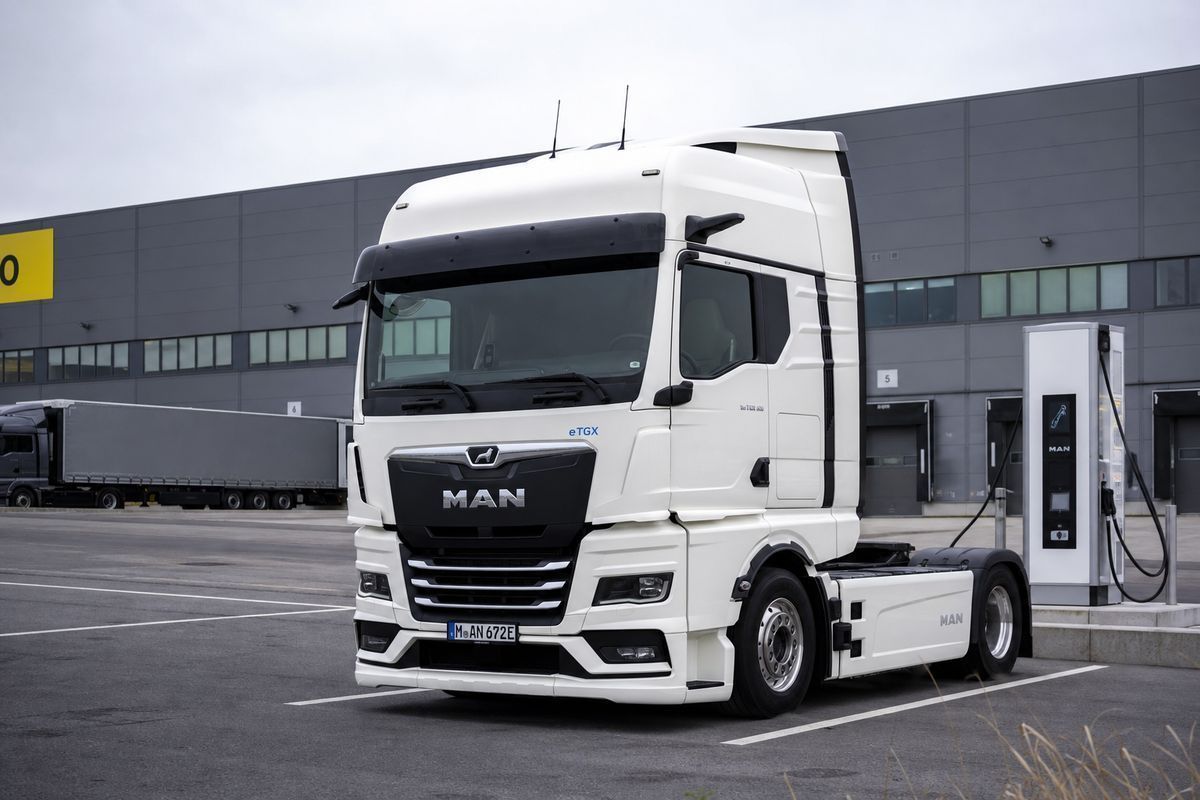
The MAN eTGX is MAN Truck & Bus’s flagship battery-electric heavy-duty tractor for long-haul and regional transport, launched in series production from 2025 with batteries manufactured in-house at Nuremberg and final assembly at Munich. It shares TGX cab architecture (GX, GM, GN) with diesel models but replaces the powertrain with a central electric drive unit integrating motor, inverter, and 2- or 4-speed transmission. Motor ratings span 254 kW (333 hp), 330 kW (449 hp), and 400 kW (544 hp) with peak torques up to 1,250 Nm at the motor (higher at wheels depending on gearing). Modular NMC battery packs deliver 240–560 kWh total capacity across 4x2 semitrailer, 4x2 chassis, and 6x2 chassis configurations. Range without intermediate charging reaches up to 570 km for classic 4x2 semitrailer tractor duty (6 packs, ~480 kWh) and up to 830 km for 6x2 chassis solo operation (7 packs, 560 kWh). Charging supports CCS up to 375 kW and Megawatt Charging System (MCS) up to 750 kW, with MAN citing ~27 minutes from 20% to 80% SoC on six packs at MCS. Indicative pricing in European markets centers around €320,000 (~$350,000 / £270,000) before incentives. For transport tractor fleets, the eTGX targets hub-to-hub linehaul, refrigerated distribution with depot or corridor MCS, and sustainability mandates—competing with Volvo FH Electric, Mercedes-Benz eActros 600, and DAF XD Electric.
2. Introduction: Electrifying the TGX Platform
MAN unveiled the eTGX alongside the shorter-range eTGS (distribution) and completes its electric TG family with eTGM and eTGL urban trucks. Unlike clean-sheet EV startups, MAN’s strategy electrifies the proven TGX chassis—preserving fifth-wheel heights, axle layouts, and driver ergonomics fleet managers already understand. The eTGX specifically addresses skepticism about BEV long-haul by pairing high pack counts with megawatt charging aligned to EU driver break regulations.
UK launch coverage in August 2024 confirmed customer-selectable pack counts (3–6 on semitrailer tractors), allowing up to 2.4 tonnes of weight reduction when fewer packs suffice—critical for maximizing payload under 40/44-tonne gross combinations.
3. Powertrain and Motor Specifications
MAN’s electric drive unit is centrally mounted where engine and gearbox traditionally sit, with additional packs along the frame rails.
| Power Rating | Continuous / Peak | Peak Motor Torque | Transmission |
|---|---|---|---|
| 254 kW (333 hp) | Entry long-haul | 800 Nm | 2-speed typical |
| 330 kW (449 hp) | Mid spec | 1,150 Nm | 2- or 4-speed |
| 400 kW (544 hp) | Top spec | 1,250 Nm | 4-speed |
MAN also references up to 400 kW continuous drive and continuous brake recuperation on grade—important for Alpine or Pennine corridors.
The integrated design reduces mechanical losses versus separate motor + axle setups and simplifies maintenance versus multi-motor hub drives.
4. Battery Architecture and Range
Batteries use NMC chemistry, 80 kWh per pack, produced at MAN Nuremberg.
| Configuration | Battery Packs | Capacity | Gross Combination | Range (no mid-route charge) |
|---|---|---|---|---|
| 4x2 Semitrailer | 4–6 | 320–480 kWh | Up to 50 t | Up to 570 km |
| 4x2 Chassis | 3–6 | 240–480 kWh | 20 t GVW / 50 t GCW | Up to 820 km (solo) |
| 6x2 Chassis | 3–7 | 240–560 kWh | 28 t GVW / 50 t GCW | Up to 830 km (solo) / 600 km with trailer |
Why it matters: Terminal tractor and linehaul operators can right-size packs—a 4-pack semitrailer tractor sheds weight for weight-out freight while a 6-pack unit targets 500+ km regional loops.
Wheelbase advantage: at 3,750 mm, MAN claims the shortest wheelbase among semitrailer tractors offering up to 480 kWh—helping comply with 16.50 m EU length limits with ISO or special trailers.
5. Charging Infrastructure
| Standard | Peak Power | Typical Use |
|---|---|---|
| CCS2 | Up to 375 kW | Depot overnight, public corridor |
| MCS (Megawatt Charging System) | Up to 750 kW | 45-minute driver break top-up |
MAN’s published MCS figure: 20–80% in ~27 minutes with six packs—sufficient for a regulatory break on many EU long-haul lanes if MCS posts are available.
Fleet implication: MCS corridor planning is the gating item for true long-haul BEV parity—not pack size alone. Depot CCS remains adequate for return-to-base regional tractors (port drayage, LTL hub spokes).
6. Cab, Comfort, and Digital Services
The eTGX retains TGX GX/GM/GN cabs with OptiView camera mirrors, rest bunk options on GM/GN, and familiar dashboard layouts—reducing driver training friction versus purpose-built EV cabs.
Standard five-year digital package includes MAN eManager M telematics, route energy prediction, and TCO tooling integration—supporting transport fleet energy procurement and charge scheduling.
7. Global Pricing and Incentives
| Market | Indicative Price | Notes |
|---|---|---|
| Germany / EU | ~€320,000 base | Before BAFA or national ZEV grants |
| United Kingdom | ~£270,000 | Plug-in truck grant eligibility varies |
| United States | Not series-launched as of 2025 | MAN focuses EU production first |
Instagram/industry reporting cites $350,000 (€320,000/£270,000) as a reference transaction band—actual net price depends on pack count, power rating, ADR equipment, and fleet rebates.
TCO drivers: electricity vs diesel per km, maintenance (no DPF/SCR), residual value uncertainty, and incentive capture. German operators often model sub-5-year payback at >80,000 km/year with favorable depot rates and grants.
8. Competitive Landscape
| Model | Battery | Range (tractor) | Peak Charge | Status |
|---|---|---|---|---|
| MAN eTGX | 240–560 kWh | Up to 570 km | 750 kW MCS | Series 2025 |
| Volvo FH Electric | 540–630 kWh | ~300 mi | 350 kW CCS | Production |
| Mercedes eActros 600 | 621 kWh | ~500 km | 400 kW CCS | Production |
| DAF XD Electric | Modular | Region-dependent | CCS | Production |
MAN’s differentiator is MCS readiness at 750 kW and pack modularity down to 3 packs—flexibility competitors are still matching.
9. Transport Tractor Applications
Strong fit:
- Return-to-depot regional linehaul (200–500 km/day)
- Hub-to-hub LTL with MCS corridor or mid-route charge
- Food/beverage and parcel fleets with sustainability targets
- Port drayage with depot megawatt charging
Weak fit:
- Unplanned long-haul without MCS network
- Weight-out bulk (aggregates, steel coils) where pack weight erodes payload
- Markets without 750 kW grid service or MCS standard adoption
For terminal tractor duty specifically, MAN positions the eTGS and Ottawa/Kalmar partnerships for yard tractors; the eTGX is a linehaul semitrailer tractor, not a spotter/y terminal unit—though its short wheelbase aids maneuverability in tight yards.
10. Real-World Deployment Notes
Series production from June 2025 at Munich main plant follows extensive winter and mountain pass testing reported in TRATON Group communications. Early adopters are expected in Germany, Austria, Benelux, and UK fleets with signed MCS corridor agreements.
Battery warranty: 3+1 years typical MAN EV policy; five-year digital services bundled.
11. Information Gaps
| Gap | Impact |
|---|---|
| US homologation timeline | NA fleet planning blocked |
| Exact kWh/mi consumption by load/terrain | TCO sensitivity |
| MCS public pricing | Corridor economics |
| Residual values at 4–5 years | Lease rate uncertainty |
12. Strategic Recommendations
- Pilot 2–4 units on fixed regional lanes with known daily km and depot or MCS availability.
- Right-size packs—do not spec 6 packs if daily duty is <300 km; payload recovery can fund MCS sessions.
- Engage utility and MCS operators 12–18 months before fleet delivery for grid upgrades.
- Leverage MAN eManager for charge scheduling against spot power prices.
- Compare eTGS for urban/regional distribution if daily range is <400 km—lower capital and weight.
13. Conclusion
The MAN eTGX 2024/2025 platform is a credible electric long-haul tractor—not a concept—combining TGX ergonomics, in-house Nuremberg batteries, and class-leading MCS charging. For European transport tractor fleets with predictable routes and charging strategy, it belongs on the shortlist alongside Volvo and Mercedes. Success hinges on infrastructure execution, not horsepower headlines. Fleets should treat pack count and MCS corridor access as primary specification decisions, because they determine both payload and effective daily range more than peak motor kilowatts alone.