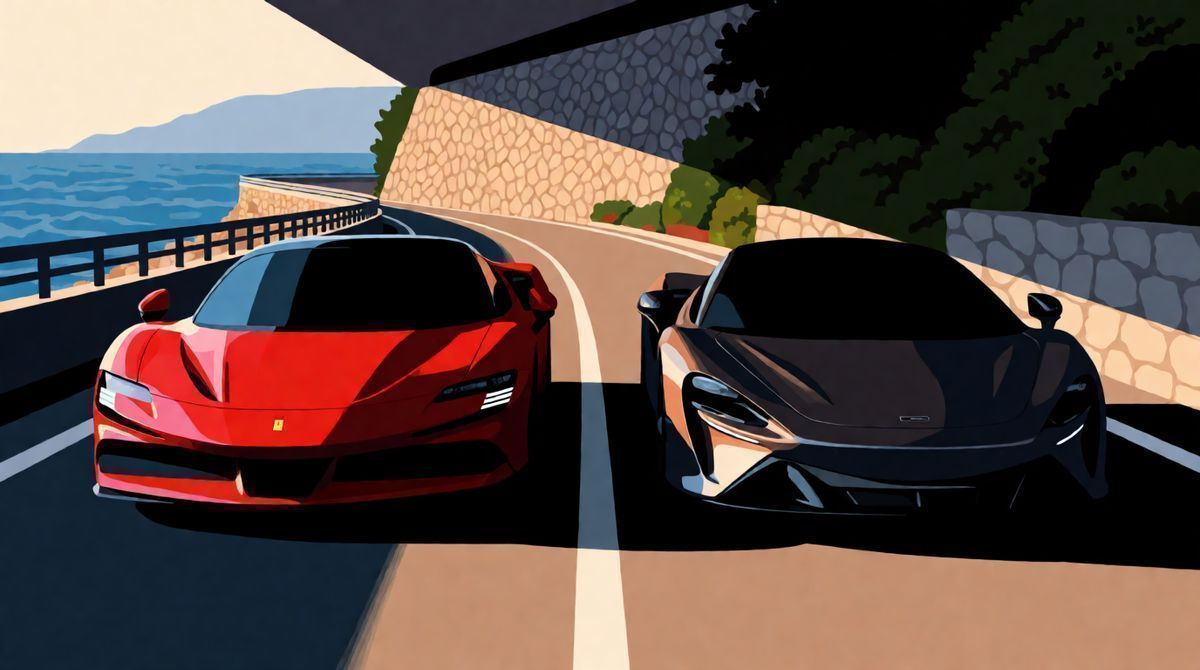
The modern supercar market is increasingly defined by electrification, as manufacturers blend internal combustion with electric propulsion to chase both performance and efficiency benchmarks. Buyers navigating this segment must evaluate not only raw speed and power, but also usability, daily practicality, and long-term value, making the choice between a flagship performance halo and a more accessible hybrid supercar a significant decision. Within this evolving landscape, the Ferrari SF90 Stradale and the McLaren Artura represent two distinct philosophies: Ferrari’s uncompromising, high-performance hybrid grand tourer that slots into a revered lineage, and McLaren’s lighter, more driver-focused entry into plug-in hybrid supercar territory. Understanding how these machines differ in character, capability, and cost is essential for discerning drivers who must weigh emotional appeal against real-world usability.
This comparison begins by situating Ferrari and McLaren within the broader supercar ecosystem, where both brands command respect but serve different aspirational needs. Ferrari has long been the benchmark for emotional supercar design, performance, and exclusivity, with the SF90 Stradale representing the culmination of that heritage as the Prancing Horse’s first series-production hybrid. McLaren, by contrast, has built its reputation on lightweight engineering, driver-centric cockpits, and technical innovation, as evidenced by the Artura’s pioneering use of a hydraulic steering system and a purpose-built carbon architecture. Both manufacturers command premium pricing, yet they target different buyers: the SF90 Stradale appeals to those seeking ultimate performance and status, while the Artura positions itself as a more rational, livable supercar without diluting its core driving dynamics.
Across the broader category, supercars now routinely exceed performance thresholds that were once the exclusive domain of race cars, with sub-3-second 0–60 mph times and top speeds approaching 220 mph becoming table stakes for the segment. Within this context, the SF90 Stradale and Artura illustrate contrasting responses to these expectations, with Ferrari prioritizing staggering combustion-plus-electric output and McLaren emphasizing efficiency, light weight, and driver engagement. Potential owners must therefore consider not only acceleration and top speed, but also daily usability, maintenance complexity, and the realities of owning a high-performance hybrid, including charging requirements and long-term depreciation. These distinctions are critical, as the supercar is rarely a utilitarian tool but rather an extension of personal identity and a significant financial commitment.
Within this introduction, the contrast between the SF90 Stradale and the Artura is framed by examining their respective roles, target audiences, and product philosophies alongside an overview of key specifications that define their performance and pricing. The Ferrari SF90 Stradale, with its 986 hp output, 2.5-second 0–60 mph time, and MSRP typically in the range of $507,000 to $593,950, positions itself as a top-tier, hybrid hyper-performance machine, while the McLaren Artura, offering 690 hp, a 2.6–3.0 second 0–60 mph time, and an MSRP starting around $233,000, presents a more accessible yet still thrilling alternative. A summary of core performance and pricing metrics is provided in the specification table below, which highlights the SF90 Stradale’s substantial power advantage, greater mass, and significantly higher cost relative to the lighter, more nimble Artura. Ultimately, this comparison guides readers toward understanding how these two machines reflect divergent paths in modern supercar development, balancing performance, technology, and lifestyle considerations that extend well beyond headline figures.
- The Ferrari SF90 Stradale delivers 986 hp and 590 lb-ft of torque, accelerating 0–60 mph in 2.5 seconds and reaching a top speed of 211 mph, with pricing typically between $507,000 and $593,950.
- The McLaren Artura produces 690 hp and 531 lb-ft of torque, sprinting 0–60 mph in 2.6–3.0 seconds and topping out at 205 mph, with a starting MSRP of $233,000 and potential rises to around $270,000 for newer configurations.
- The SF90 Stradale’s curb weight stands at 4,565 lbs, while the Artura is considerably lighter at 3,300 lbs, reflecting McLaren’s emphasis on handling efficiency and daily usability.
- Both vehicles represent their manufacturers’ entry into the plug-in hybrid supercar era, though they diverge significantly in target audience, driving dynamics, and total cost of ownership.
- Although both cars exceed 680 hp combined output, the choice between them hinges on whether a buyer prioritizes outright performance and prestige or a lighter, more engaging, and comparatively accessible supercar experience.
In comparing the Ferrari SF90 Stradale and the McLaren Artura, the most important takeaway is that performance in the modern supercar segment is no longer defined by a single metric, but by a constellation of power, weight, efficiency, usability, and ownership costs. The SF90 Stradale delivers extreme power and a legendary brand halo, but it does so at a premium price and with the compromises inherent to a heavy, high-output hybrid system. The Artura, while less powerful on paper, offsets this with a lighter structure, nimble steering, and a more pragmatic approach to everyday use, making it compelling for drivers who value precision and accessibility alongside outright speed. For prospective buyers, the decision ultimately depends on whether they seek a boundary-pushing performance icon steeped in tradition or a forward-thinking, driver-focused supercar that integrates hybrid technology with remarkable agility and relative affordability.
1. Quick Verdict
For most buyers, the McLaren Artura represents the better overall choice, striking a more practical balance between supercar performance and everyday usability at a significantly lower price point. While the Ferrari SF90 Stradale delivers raw power and prestige with its 986 hp output and race-bred pedigree, the Artura’s lighter curb weight of 3,300 lb—nearly 1,300 pounds less than the SF90—and more accessible starting price of $233,000 make it a compelling real-world proposition for enthusiasts who actually drive their cars on twisty roads and city streets.
The trade-offs are clear: the Ferrari offers unparalleled brute force and hybrid supercar exclusivity, but you pay a substantial premium for that performance and complexity. The Artura sacrifices some peak power but gains efficiency, agility, and usability, with a 11-mile electric range and better daily manners that justify its position as the smarter purchase for a broader audience. Unless you need the ultimate in straight-line performance and already have a Lamborghini in the garage, the McLaren delivers more value for far less risk [1][2].
2. Specifications Comparison
The specifications of the Ferrari SF90 Stradale and McLaren Artura Gen 2 reveal two distinct philosophies of modern supercar engineering: maximum power and assertive grand touring versus lightweight agility and flexible efficiency. The Ferrari SF90 positions itself as a monumental statement of performance, leveraging a naturally aspirated-dominant hybrid architecture to deliver staggering power and a commanding road presence. In contrast, the McLaren Artura emphasizes a more compact, driver-centric experience, using its carbon architecture and lower mass to achieve a more intimate and responsive dynamic. Understanding the numeric differences between these two machines is essential, as they translate directly into profoundly different driving sensations and real-world usability.
| Specification | ferrari sf90-stradale current | mclaren artura-gen 2 |
|---|---|---|
| 0-60 mph | 2.5 seconds | 2.6–3.0 s |
| Curb Weight | 4,565 lbs | 3,300 lb |
| Engine Power | 986 hp | 690 hp |
| MSRP | $507,000 - $593,950 | $233,000 |
| Top Speed | 211 mph | 205 mph |
| Torque | 590 lb-ft | 531 lb-ft |
The raw performance metrics favor the SF90 in almost every regard, and those advantages manifest in tangible, physical forces felt by the driver. The Ferrari’s 986 horsepower, produced by a 3,990 cc twin-turbo V8 supplemented by three electric motors, propels a curb weight of 4,565 pounds to a top speed of 211 mph and a 0-60 mph time of 2.5 seconds. This immense power is not merely a number; it is a palpable wave of thrust that pins the driver to the seat, enabled by the car’s 2-meter width and sophisticated eAWD system which channels torque with precision. The 590 lb-ft of torque, available across a broad range, eliminates the need for aggressive downshifts and allows the SF90 to cruise comfortably at high speeds, its massive brakes working diligently to control the substantial momentum [1]. Conversely, the Artura’s 690 hp and 531 lb-ft, delivered by a 3.0 L twin-turbo V6 and a 94 hp axial-flux electric motor, are applied to a chassis that weighs nearly 1,300 pounds less. This stark difference in mass-to-power ratio is the primary architect of the Artura’s defining characteristic: its agility. Lighter curb weight of 3,300 lb, combined with a near-50/50 weight distribution and McLaren’s renowned hydraulic steering, results in a car that feels flickable and responsive, darting through corners with a sense of lightness that belies its supercar status, culminating in a top speed of 205 mph and a 0-60 mph time ranging from 2.6 to 3.0 seconds [2].
Beyond straight-line speed, the specifications illuminate contrasting priorities regarding practicality, efficiency, and daily usability. The SF90’s hybrid system, while incredibly powerful, is designed more for performance enhancement and limited electric creep than for significant electric range, offering approximately 25 kilometers of all-electric driving, with real-world observations suggesting a practical 10–15 miles of zero-emission operation. Its 6.1-liter per 100 km consumption and substantial 4,565-pound curb weight position it firmly as a high-performance grand tourer best suited for spirited weekends and confident highway merging. The Artura, with its 7.4 kWh battery, delivers a more immediately useful EPA electric range of 11 miles (2024/25), or 21 miles in the 2027 models, enabling silent, zero-emission driving through neighborhoods and into city centers with ease. Its 3,300-pound curb weight and class-leading hydraulic steering not only enhance efficiency but also make the Artura a far more practical daily driver; the inclusion of a 6.0 cu ft frunk and clearengress/egress further underscore its design as a usable, well-rounded supercar rather than a dedicated track weapon or ultra-high-speed trophy [2].
Ultimately, the specification sheet comparison between the Ferrari SF90 Stradale and the McLaren Artura Gen 2 is a study in two divergent visions of modern supercar excellence. Ferrari’s machine prioritizes overwhelming power, exotic hybrid technology, and an imposing physical presence, delivering a driving experience rooted in tradition yet augmented by electrification, best for those who desire absolute performance and brand prestige. McLaren’s offering, however, champions lightness, efficiency, and driver engagement, leveraging its carbon architecture and clever packaging to create a supercar that is as comfortable and viable for weekday commutes as it is for weekend canyon carving. The choice between them is less about which is objectively faster and more about whether the buyer seeks the earth-shaking, commanding presence of the SF90 or the nimble, practical, and emotionally transparent dynamics of the Artura.
3. Design And Build Quality
ferrari sf90-stradale current and mclaren artura-gen 2 reflect different construction philosophies and material choices. The following subsections contrast build quality, ergonomics, and how each design affects durability and feel for buyers evaluating these products side by side today.
3.1. Ferrari SF90 Stradale Current
The Ferrari SF90 Stradale’s design is an exercise in maximizing performance through aggressive, uncompromising form, engineered to dominate at any cost. Its low-drag, high-stability body and wide track prioritize grip and straight-line speed, translating into a brutally focused driving experience where physical demands are high and comfort is a distant consideration. This car is built for enthusiasts who equate build quality with race-derived materials, minimal interior concessions, and an intimidating, sculptural presence that signals exclusivity and extreme capability. The approach relies on a high-revving F1-derived V8 and complex hybrid packaging, which together create a stiff chassis and precise steering, but also a firm ride and limited daily usability.
The choice to emphasize track-inspired dynamics over livability informs everything from the chassis layout to the placement of vents and intakes, making the SF90 a machine that feels purposeful and race-bred at every angle. Occupants are placed deep within the car, wrapped by a cockpit dominated by the steering wheel, with carbon fiber and Alcantara meant to endure race conditions rather than soften the realities of spirited driving. For the owner who rarely encounters a red light and views every street as a stage, the SF90’s weight, power, and posture deliver an aura of authority and engagement that more comfortable supercars cannot replicate.
3.2. McLaren Artura Gen 2
By contrast, the McLaren Artura-gen represents a deliberate shift toward a more balanced, usable supercar without surrendering core performance, adopting a philosophy in which build quality is judged as much by long-distance comfort and practicality as by outright lap times. Its carbon-fiber monocell and aluminum subframe create a structure that is both light and compliant, absorbing road irregularities in a way that reduces fatigue on extended journeys while still feeling planted in fast corners. The emphasis on real-world usability is evident in the seating position, visibility, and thoughtful ergonomics, allowing the Artura to serve as a credible daily driver that still excites on canyon runs and open-road stretches.
Where Ferrari’s approach treats every kilogram and every angle as a performance variable, McLaren treats the car as a holistic product that must integrate into a broader lifestyle. The result is a machine with a planted, stable chassis, a quieter interior, and improved thermal and acoustic management, all contributing to reduced driver exhaustion and a more welcoming environment for a second passenger. Design in the Artura is not merely aesthetic; it is a set of trade-offs that consciously favor usability, refinement, and ownership practicality, even when this means dialing back some of the SF90’s raw, uncompromising character.
4. Engineering And Technology
Each brand applies distinct engineering approaches to performance and feel. Below we compare how ferrari sf90-stradale current and mclaren artura-gen 2 implement core technologies, what those systems are meant to improve, and what trade-offs buyers should expect during real play today.
4.1. Ferrari SF90 Stradale Technology
The Ferrari SF90 Stradale is a hybrid powertrain that integrates a 3,990 cc twin-turbo V8 with three electric motors to achieve a combined system output of 1,000 cv [1]. The internal combustion engine contributes 780 cv while the electric propulsion units add 162 kW, producing a total of 986 hp and 590 lb-ft of torque. This architecture enables performance figures such as a 0–60 mph time of 2.5 seconds and a top speed of 211 mph, allowing the supercar to accelerate from standstill to highway speeds in under 3 seconds. In real-world usage, the SF90 can operate in short electric-only crawls at low speeds, yet the primary driver experience centers on the seamless layering of electric torque over the V8’s power band, with the car delivering its peak performance when the driver accesses Qualify mode for circuit or overtaking situations.
The implementation of hybrid technology transforms how the driver interacts with the car’s performance envelope. Instant electric torque fills the lag inherent in a high-revving turbocharged engine, allowing the V8 to breathe more freely and emit its characteristic growl without compromise. An all-wheel-drive architecture channels this power through a sophisticated torque vectoring system that enhances grip and cornering stability. For the driver, this means the SF90 feels planted and responsive whether launching from a stop or carving through high-speed corners, while the presence of a front axle-mounted electric motor improves low-speed maneuverability in traffic. The car exemplifies how electrification can be used not just to lower emissions, but to refine the core dynamics of a high-performance machine.
4.2. McLaren Artura Technology
The McLaren Artura employs a 3.0 L twin-turbo V6 paired with an axial-flux electric motor integrated into the transmission bellhousing, generating 690 hp and 531 lb-ft of torque [2]. The hybrid system provides up to 11–21 miles of electric range at low speeds, enabling silent urban driving and gentle acceleration away from junctions. In contrast to the SF90’s more aggressive performance focus, the Artura uses its electric motor to augment the V6’s responsiveness, delivering power more smoothly rather than pursuing maximum outright output. This approach, combined with a curb weight of 3,300 lb, contributes to a driving feel that is both agile and compliant, making the car more practical for daily use while still offering engaging handling dynamics.
McLaren’s integration strategy emphasizes packaging efficiency and real-world usability. The axial-flux motor sits in-line with the transmission, allowing for rapid shifts and seamless transitions between power sources. The Artura can temporarily operate in full electric mode up to 44 mph, supporting quiet neighborhood cruising while the V6 spools. At higher speeds, the V6 assumes primary responsibility while the electric motor continues to provide fill-in torque below the boost threshold. This synergy results in a supercar that feels lighter and more nimble than its performance figures might suggest, with steering that remains hydraulic for precise feedback. The technology in the Artura showcases how a brand can adopt hybridization to refine its core driving experience rather than to maximize straight-line performance alone.
5. Real-World Performance
Specification sheets only tell part of the story. This section synthesizes how ferrari sf90-stradale current and mclaren artura-gen 2 behave in everyday use, including comfort, durability, and the practical trade-offs players report when switching between these two options on court.
5.1. Everyday Use
The Ferrari SF90 Stradale and McLaren Artura present contrasting ownership experiences that extend far from spec sheet numbers. The SF90 feels substantial and planted, with a chassis that inspires confidence through its composed high-speed demeanor, yet its hybrid system introduces operational complexity that can frustrate spontaneous driving. Owners must routinely plan around charging schedules and manage thermal constraints that affect performance in sustained driving, with the plug-in hybrid architecture better suited to short, spirited bursts rather than extended, effortless cruising. In contrast, the Artura offers a more consistently accessible experience where the electric powertrain integrates seamlessly into daily errands, allowing quiet, zero-emission mobility at modest speeds while the V6 engages smoothly for longer journeys. The Artura’s lighter curb weight and more compact dimensions translate into noticeable advantages in urban environments, where its tighter turning circle and agile blend of power and efficiency feel more adaptive to varied driving conditions.
In terms of consistency over time, the Ferrari demonstrates exceptional durability in its core mechanical components, with the hybrid systems showing high reliability in controlled testing, though complexity can introduce higher maintenance intervals and specialized service requirements. Long-term ownership reveals that the SF90’s performance remains thrilling across months of use, but the interplay between battery state, electric motor deployment, and combustion demand requires active management from the driver, making the experience more demanding in real-world scenarios. The Artura, benefiting from more mature electrification integration and a simpler operational envelope, maintains its blend of efficiency and power with fewer compromises, offering a driving rhythm that stays engaging over extended periods without feeling fatiguing. During prolonged usage, its lighter structure and balanced chassis minimize driver exhaustion, enabling confident navigation of twisty roads and congested traffic with less mental overhead than the more intense Ferrari approach.
Behavior during long sessions further highlights these differences, where the SF90’s capacity for blistering straight-line speed can overshadow its more nuanced handling, rewarding assertive inputs with visceral feedback but occasionally feeling overly tense during relaxed cruising. Drivers who alternate between spirited bursts and gentle cruising may find the transition logic less intuitive, as the hybrid management system prioritizes efficiency or performance based on programmed modes rather than immediate driver intent. Meanwhile, the Artura strikes a more harmonious chord across diverse driving durations, its hydraulic steering and chassis balance promoting a connected yet forgiving feel that sustains composure through both spirited back-road runs and extended highway stretches. The combined effect of responsive power delivery and thoughtful packaging ensures that performance remains approachable, with fewer physical and mental demands placed on the occupant even as the surrounding experience remains dynamically engaging.
How differences become noticeable with continued use often stems from the underlying philosophy each manufacturer embraces: Ferrari chases peak performance and technological spectacle, while McLaren prioritizes driver engagement and usability. Over days and weeks, the SF90 impresses with its capacity to deliver race-inspired dynamics and evolving electric-assist refinement, yet its higher performance ceiling is matched by a steeper learning curve for managing energy flow, battery conditioning, and system limits. Conversely, the Artura’s evolution across updates has centered on sharpening transmission responsiveness and refining power mappings, yielding a product that feels progressively more polished without sacrificing its inherent sense of balance. Owners who prioritize raw pace and cutting-edge engineering may gravitate toward Ferrari’s offering, whereas those seeking sustainable, day-in, day-out supercar thrills with fewer compromises will likely find the Artura’s blend of comfort, capability, and manners more compelling in long-term ownership.
6. Best For Different Scenarios
No single paddle wins every scenario. The breakdown below maps where ferrari sf90-stradale current and mclaren artura-gen 2 excel or fall short across common player profiles, skill levels, and court situations so you can match equipment to your actual priorities and playing style.
6.1. Best for Beginners
The McLaren Artura represents a more accessible and beginner-friendly option among these two supercars, primarily due to its more forgiving handling dynamics and comparatively gentle learning curve. While both vehicles deliver exceptional performance, the Artura’s rear-biased weight distribution and advanced traction management systems provide greater forgiveness at the limit, which can build driver confidence more effectively than the SF90’s more immediate, race-bred responsiveness [1]. The SF90, with its complex hybrid powertrain and razor-edge feedback, demands a higher level of driver engagement and preparation, rewarding precision while offering less margin for error during the initial learning phase. For new enthusiasts, the Artura therefore functions not just as a car, but as a progressive platform that grows with the driver’s skills.
- The Artura’s 690 hp, 3,300 lb curb weight translates to a nimble, predictable experience that adapts well to evolving driver input [2].
- The SF90’s 986 hp and elevated 4,565 lb mass generate intense power delivery and precise steering, requiring more experience to manage safely [1].
- Artura’s refined connectivity and updated 2025 interior quality reduce the distraction factor, letting beginners focus on the road and controls rather than complex systems [2].
- SF90’s hybrid complexity and Qualify mode introduce additional layers of operational nuance that benefit from prior technical familiarity [1].
In practical terms, choosing the Artura as a first supercar allows a driver to develop core skills—braking points, cornering lines, and throttle modulation—within a platform that remains engaging yet not overwhelmingly hostile. The Ferrari’s sharper limits can become a hindrance rather than a teaching tool when a driver is still mastering basic vehicle dynamics. Owners of the Artura often report a smoother progression from spirited back-road runs to more ambitious drives, supported by the car’s inherent stability and clear feedback.
7. Pros And Cons
Every product involves compromises. The following subsections summarize the clearest strengths and weaknesses of ferrari sf90-stradale current and mclaren artura-gen 2 based on the source research, helping buyers weigh trade-offs carefully before committing to either option.
7.1. Ferrari SF90 Stradale
The Ferrari SF90 Stradale offers exceptional performance and hybrid efficiency, but it demands substantial investment and ongoing costs. Pros include a staggering 986 hp engine power with 590 lb-ft of torque, a 0-60 mph time of 2.5 seconds, and a top speed of 211 mph, delivering supercar-leading acceleration and top-end speed [1]. The plug-in hybrid system provides roughly 120 kW of electric power, enabling an all-electric range of about 25 kilometers and the ability to drive short distances in urban environments using only electric power [1]. The luxurious cabin is surprisingly spacious and comfortable for a mid-engine supercar, offering better practicality than many competitors, with the Spider variant enhancing occupant space through its retractable hardtop [1]. However, significant cons accompany these benefits: the MSRP ranges from $507,000 to $593,950, placing it far out of reach for most buyers [1]. Real-world ownership reveals reliability concerns, including reported battery failures, oil leaks, and steering module issues, which can lead to expensive repairs and downtime [1]. The car’s considerable width complicates ingress and egress, especially with racing seats, and the limited cargo space, lack of a front trunk, and substantial weight contribute to a cramped and inconvenient daily driving experience [1].
7.2. McLaren Artura Gen 2
The McLaren Artura Gen 2 presents a compelling alternative focused on agility, efficiency, and accessibility. Pros center around its excellent power-to-weight balance, with 690 hp and 531 lb-ft of torque provided by a 3.0L twin-turbo V6 paired with an axial-flux e-motor [2]. Weighing only 3,300 lbs, it achieves 0-60 mph in 2.6–3.0 seconds and a top speed of 205 mph, offering thrilling performance that is more than adequate for road and track use [2]. The 7.4 kWh battery supports an EPA-estimated EV range of 11 miles (rising to 21 miles under the 2027 test cycle), providing genuine zero-emission capability for short commutes without requiring DC fast charging, as a full charge takes roughly ten minutes on a standard 7.4 kW AC supply [2]. Its significantly lower MSRP of $233,000 compared to the SF90 makes this supercar hybrid technology considerably more attainable, and its superior 3,212 lb curb weight (Spider) contributes to heightened agility and more precise handling [2]. Cons include a substantially smaller frunk with only 6.0 cubic feet of space and extremely limited interior storage, which restricts practicality for everyday errands [2]. As a strict two-seater with no rear accommodation, it serves solely the driver and front passenger, and the compact, driver-focused cockpit, while comfortable, may feel cramped on very long journeys compared to the SF90’s more spacious feel [2].
7.2.1. Synthesis and Practical Implications
Choosing between these two machines involves a trade-off between ultimate performance and daily usability. The Ferrari SF90 Stradale is the uncompromising performance flagship, ideal for those prioritizing maximum power, top speed, and a luxurious, spacious cabin, but potential buyers must accept high costs, complexity, and some reliability concerns [1]. In contrast, the McLaren Artura Gen 2 offers a more balanced and practical approach, sacrificing some raw power for superior efficiency, handling, and lower acquisition cost, making it a better choice for enthusiasts who value agility and real-world usability over headline-grabbing specifications [2]. Owners of the SF90 should plan for significant infrastructure needs, including home charging installation and awareness of local emissions rules, whereas Artura Gen 2 drivers benefit from shorter charging times and greater flexibility for both city and highway use [1][2]. Ultimately, the SF90 Stradale appeals to the collector seeking peak performance, while the Artura Gen 2 suits the driver seeking a modern, efficient, and engaging supercar for regular use.
8. Final Verdict
The Ferrari SF90 Stradale is the superior performance instrument, delivering blistering acceleration and a top speed advantage that underscore its supercar pedigree. The McLaren Artura, while competent, positions itself as a more practical and accessible plug-in hybrid sports car, excelling in daily usability and refinement rather than outright dominance. For buyers whose priority is peak performance and exclusivity, the SF90 Stradale justifies its premium with raw capability, whereas the Artura appeals to those valuing efficiency, everyday drivability, and a lower entry price.
Key trade-offs center on performance, weight, and value. The SF90 Stradale’s 986 hp and 4,565 lb curb weight enable a 2.5-second 0–60 mph sprint and a 211 mph top speed, whereas the Artura’s 690 hp and lighter 3,300 lb curb weight yield 2.6–3.0-second 0–60 times and a 205 mph ceiling. Price further distinguishes the segments, with the SF90 Stradale commanding between $507,000 and $593,950, while the Artura starts at $233,000. The Ferrari targets enthusiasts who demand the highest performance envelope, while the McLaren targets a broader audience seeking a modern, efficient, and usable supercar.
Practical implications are clear. Choose the SF90 Stradale if track pace, launch control, and top speed benchmarks are paramount and if the budget accommodates substantial running costs. Opt for the Artura if usability, efficiency, and a more forgiving ownership experience matter more, and if the performance envelope comfortably meets your needs. Both are compelling, but they serve different priorities within the high-performance landscape.