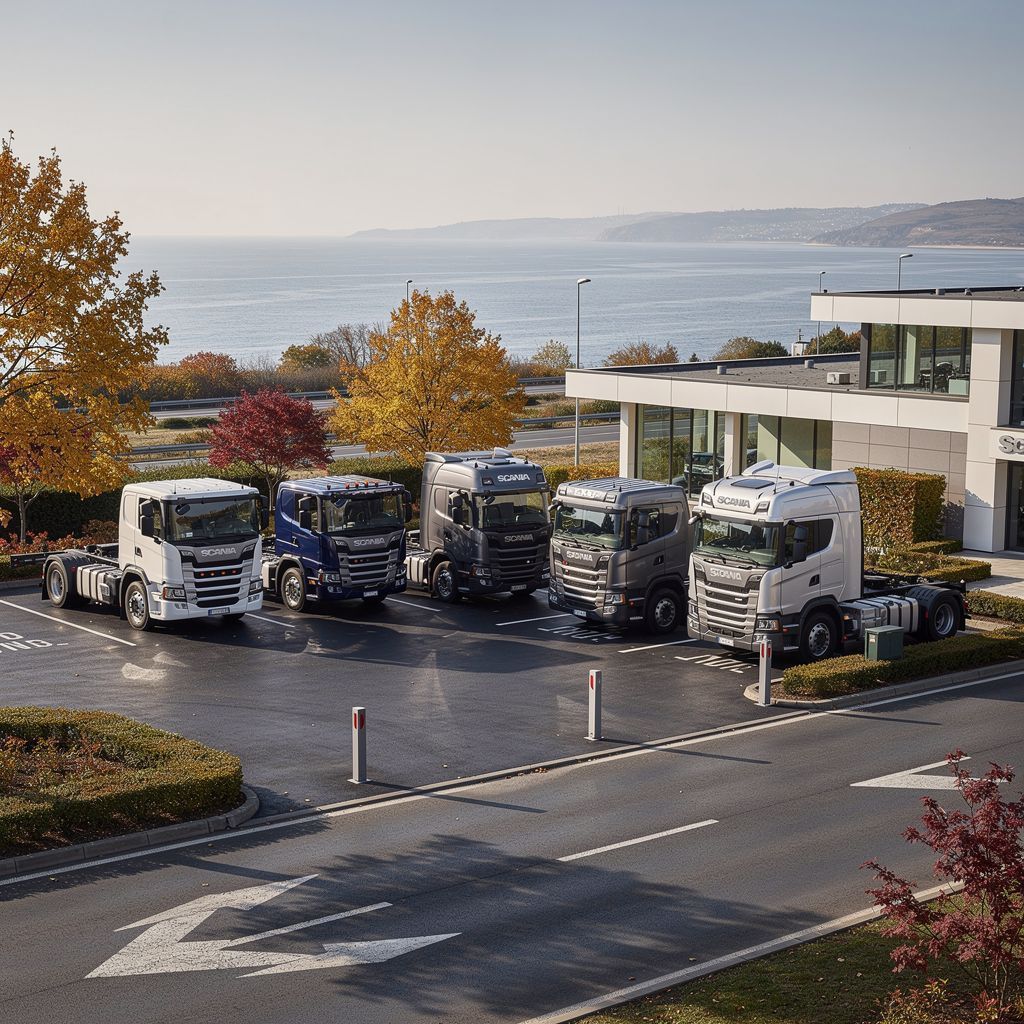
The transport tractor category sits at the intersection of logistics efficiency and industrial automation, where equipment choice directly determines throughput capacity, labor economics, and emissions compliance across ports, distribution centers, and intermodal hubs. Terminal tractors—purpose-built for shuttling semi-trailers between loading docks, storage yards, and railcars at low speeds of 15–25 mph—have traditionally relied on diesel powertrains and human operators to maintain continuous flow in high-density environments. The emergence of battery-electric and autonomous variants introduces new variables into fleet planning: charging infrastructure capital expenditure, uptime guarantees during peak shifts, and the integration of autonomous navigation with existing yard management systems. These decisions cascade into total cost of ownership calculations that span energy procurement, maintenance intervals, and residual value risk, making technical specification transparency a prerequisite for credible procurement strategies [1].
Kalmar and MAN occupy distinct but occasionally overlapping positions in the commercial vehicle landscape, each bringing decades of domain expertise to electrification and automation. Kalmar, a Cargotec brand, has built its reputation on cargo-handling equipment for ports and terminals, with a product portfolio spanning reachstackers, forklifts, and terminal tractors that emphasize maneuverability in confined spaces and integration with terminal operating systems. Its autonomous AutoTT program reflects a philosophy of removing the operator entirely from repetitive yard cycles, targeting 24/7 operation in controlled environments where predictable routes and geofenced boundaries reduce complexity. MAN Truck & Bus, by contrast, approaches electrification through the lens of long-haul and regional linehaul, leveraging the proven TGX platform architecture to preserve fifth-wheel heights, axle layouts, and driver ergonomics that fleet managers already specify. The eTGX’s in-house battery production at Nuremberg and final assembly at Munich signal a vertically integrated strategy aimed at controlling cost and supply continuity for high-volume highway applications [2].
The product category fractures along duty-cycle lines that dictate fundamentally different engineering priorities and user profiles. Terminal tractors like the Kalmar AutoTT excel in short-haul, high-frequency shuttle moves within geofenced yards—moving trailers between dock doors and staging lanes where maneuverability, low-speed torque, and autonomous precision outweigh range or highway speed. These units serve logistics operators, port authorities, and industrial shippers who measure productivity in moves per hour and labor hours eliminated. Highway tractors like the MAN eTGX address a contrasting profile: hub-to-hub linehaul of 200–500 km per day, where range per charge, megawatt charging alignment with EU driver break regulations, and payload preservation under 40/44-tonne gross combination weights dominate the specification sheet. A third segment—regional distribution and port drayage—sits between these poles, served by vehicles like MAN’s eTGS and Kalmar’s Ottawa terminal tractor line, where daily return-to-depot cycles enable depot charging but road legality remains mandatory [1, 2].
This comparison juxtaposes the Kalmar AutoTT 2024, an autonomous electric terminal tractor slated for commercial availability in late 2026 with undisclosed battery capacity and pricing, against the MAN eTGX 2024, a series-production battery-electric highway tractor launching in 2025 with up to 560 kWh capacity, 570 km range, MCS charging, and a reference price of €320,000 (~$350,000). The contrast is instructive precisely because the two vehicles occupy adjacent but non-competing niches: the AutoTT eliminates the driver for yard confinement, while the eTGX retains the cab for cross-border linehaul. Yet both represent their manufacturers’ bets on how electrification and automation will reshape freight movement—Kalmar by removing the operator from the loop, MAN by electrifying the platform without disrupting the driver’s role. Understanding where each succeeds, where specifications remain opaque, and how their respective ecosystems (charging, service, software integration) mature will determine which fleets adopt which platform, and whether the boundary between yard and highway eventually blurs [1, 2].
1. Quick Verdict
The MAN eTGX emerges as the more concretely defined proposition for fleets evaluating immediate electrification options, offering disclosed performance figures—400 kW peak power, 1,250 Nm torque, up to 570 km range on a 4x2 semitrailer configuration—and a clear price point around €320,000 with series production starting in 2025 [2]. In contrast, the Kalmar AutoTT remains a pre-commercial autonomous terminal tractor targeting late 2026 deployment, with critical specifications such as battery capacity, lift capacity, and pricing still undisclosed, making direct performance comparison impossible at this stage [1].
The fundamental trade-off lies in application scope: the MAN eTGX addresses long-haul and regional linehaul duties with megawatt charging capability (MCS up to 750 kW) and modular battery packs up to 560 kWh, positioning it against Volvo FH Electric and Mercedes-Benz eActros 600 for corridor transport [2]. The Kalmar AutoTT, however, targets a niche autonomous yard and terminal environment, integrating Forterra’s AutoDrive® platform with Kalmar One fleet management for mixed-traffic logistics hubs, where zero-emission short-haul shuttling replaces manual tractor operations [1]. Fleets needing highway-range electric tractors today have a viable, specced option in the eTGX, while terminal operators seeking autonomy must monitor Kalmar’s upcoming disclosures to assess total cost of ownership and integration maturity.
2. Specifications Comparison
Understanding the specifications of the Kalmar AutoTT 2024 and the MAN eTGX 2024 requires looking beyond raw numbers to grasp how each vehicle’s engineering philosophy translates into daily operational reality. Weight, power delivery, and energy architecture dictate not just performance metrics but the very workflows they enable: a terminal tractor operating autonomously in a congested yard demands instantaneous torque response and fail-safe redundancy, while a long-haul semitrailer tractor must balance gross combination weight against range anxiety and charging downtime. The materials and technology choices — from battery chemistry to drive-unit integration — cascade into maintenance intervals, infrastructure dependencies, and ultimately the total cost of ownership that fleet managers must justify [1][2].
The design philosophy behind each product could not be more distinct. Kalmar’s AutoTT is built from the ground up as an autonomous, zero-emission yard tractor, leveraging Forterra’s AutoDrive® platform and certified cable-based safety systems to navigate mixed-traffic environments where pedestrians, forklifts, and manual trucks coexist. Its development prioritizes sensor fusion, collision avoidance, and phased safety validation over headline power figures, reflecting a market where reliability in unpredictable settings outweighs raw speed. MAN, by contrast, has electrified the proven TGX chassis, preserving fifth-wheel heights, axle layouts, and driver ergonomics that fleet managers already trust. The eTGX’s modular NMC battery packs — selectable from three to seven units — let operators right-size weight and range for specific duty cycles, from 200 km regional loops to 500+ km corridor runs with megawatt charging during mandated driver breaks [2].
For the user, these philosophies manifest in tangibly different experiences. An operator introducing the AutoTT will feel the absence of a driver’s cab entirely; the “experience” becomes one of remote supervision, exception handling, and integration with Kalmar One fleet management, with productivity measured in autonomous hours completed without intervention. A driver climbing into the eTGX, however, encounters a familiar TGX cockpit augmented by electric-specific displays, enjoying the quiet, vibration-free thrust of up to 400 kW continuous power and the confidence of 1,250 Nm peak torque available instantly — but must plan routes around the nascent MCS corridor network and accept that payload capacity shrinks with every additional battery pack added for range [1][2].
The table below captures the core specifications currently available for each platform, laying bare the asymmetry in disclosure: one vehicle remains in pre-commercial validation with key performance data withheld, while the other enters series production with a full menu of power, torque, weight, and pricing options.
| Specification | kalmar autott 2024 | man etgx 2024 |
|---|---|---|
| Engine Power | Not disclosed | 400 kW peak (544 hp) |
| MSRP | Not disclosed | |
| Torque | Not disclosed | 1,250 Nm peak motor torque |
| Weight | Not disclosed | Up to 2.4 t saved with fewer battery packs |
The most immediate takeaway is the transparency gap. MAN publishes a complete powertrain ladder — three power ratings from 254 kW to 400 kW, corresponding torque steps from 800 Nm to 1,250 Nm, and a choice of two- or four-speed transmissions — enabling buyers to match specification to duty cycle with precision. Kalmar’s silence on engine power and torque for the AutoTT forces prospective customers to rely on proxy data from the Ottawa T2EV or Kalmar’s Gen 2 reachstacker batteries, which suggest a modular lithium-ion architecture capable of roughly 10 hours continuous operation but offer no guarantee of equivalence. In practice, this means a fleet evaluating the eTGX can model gradeability, acceleration, and energy consumption per kilometer today, while an AutoTT evaluator must wait for late-2026 deployment data to validate whether the autonomous platform can sustain a full shift without opportunity charging [1][2].
Weight and pricing disparities further sharpen the contrast. MAN’s explicit “up to 2.4 t saved with fewer battery packs” quantifies a direct payload advantage: a 4-pack semitrailer tractor shedding roughly two tonnes versus a 6-pack unit translates into additional freight revenue on weight-limited 40/44-tonne gross combinations. The ~€320,000 MSRP anchors total-cost-of-ownership calculations against diesel TGX equivalents and rival BEVs from Volvo and Mercedes. Kalmar’s undisclosed weight and price leave a vacuum that can only be filled by assumptions — likely benchmarked against the manual T2 series and Ottawa T2EV — but without committed figures, ROI models remain speculative. For a terminal operator, the unknown weight impacts trailer coupling compatibility and yard surface loading; for a financial controller, the missing MSRP blocks capex approval. Until Kalmar publishes these fundamentals, the AutoTT remains a strategic intent rather than a specifiable asset [1][2].
In practical terms, the specification comparison reveals two vehicles solving different problems at different readiness levels. The MAN eTGX is a today solution for European long-haul and regional fleets with predictable routes and access to depot or MCS charging; its configurable battery packs, proven chassis, and published performance envelope make it a credible diesel replacement on defined lanes. The Kalmar AutoTT is a tomorrow solution for yard and terminal operators seeking to automate mixed-traffic moves; its value will be proven not by peak kilowatts but by autonomous uptime, safety certification, and integration with Kalmar One — metrics that simply do not exist in a conventional spec sheet. Buyers with immediate decarbonization mandates on highway corridors have a clear, orderable path with the eTGX. Buyers planning yard automation for 2027 and beyond should engage Kalmar now to shape requirements, but cannot yet write a purchase specification [1][2].
3. Design And Build Quality
The Kalmar AutoTT and MAN eTGX represent fundamentally different approaches to commercial vehicle electrification and automation. Kalmar has engineered a purpose-built autonomous terminal tractor from the ground up, eliminating the driver’s cab entirely to prioritize maneuverability in confined yard environments where mixed-traffic coordination with forklifts, manual trucks, and pedestrians is the daily reality [1]. MAN, by contrast, has adapted its proven Class 8 truck architecture by centrally mounting an electric drive unit where the diesel engine and gearbox traditionally reside, positioning battery packs along the frame rails to create an electric long-haul tractor that retains the familiar proportions and operational flexibility of its conventional counterparts [2].
These divergent philosophies cascade into every aspect of design and build quality. The AutoTT’s cab-less architecture enables a compact footprint and steering geometry optimized for 15–25 mph operations in high-density terminals, while the eTGX’s frame-integrated powertrain preserves the structural continuity required for 500+ kilometer highway duties with up to 400 kW continuous power and regenerative braking on alpine grades [2]. Understanding how these foundational choices affect usability, durability, and total cost of ownership requires examining each vehicle on its own terms before drawing direct comparisons.
3.1. Kalmar AutoTT 2024
Kalmar’s design philosophy centers on solving a specific logistics bottleneck: the need for continuous, autonomous trailer repositioning in mixed-traffic yards without human operators on board. By removing the cab entirely, the AutoTT achieves a compact footprint and steering mechanics tailored for tight spaces where conventional terminal tractors struggle to maneuver between loading docks, storage rows, and railcars [1]. This cab-less architecture is not merely a styling choice — it directly enables 24/7 operation by eliminating driver shift changes and fatigue cycles, allowing the vehicle to integrate seamlessly with automated warehouse management systems that orchestrate trailer movements in real time. The diesel-powered Ottawa T2 AutoTT variant, slated for late 2026 North American availability, serves as a transitional bridge that leverages existing fueling infrastructure while Kalmar refines its autonomous navigation stack before the zero-emission T2EV AutoTT arrives post-2027 [1].
The trade-offs inherent in this purpose-built approach are significant. Critical transport specifications — maximum towing capacity, acceleration, turning radius, payload limits, and operational range — remain undisclosed, creating uncertainty for logistics managers evaluating whether the AutoTT can handle fully loaded 53-foot trailers in time-sensitive environments [1]. While Kalmar’s existing T2 series tractors offer up to 70,000 pounds of towing capacity, the integration of sensor arrays, autonomous computing hardware, and battery modules may alter weight distribution and structural dynamics in ways that affect real-world performance [1]. The modular lithium-ion battery architecture from the Kalmar T2 EV (150 kW charging, six-year/2,800-cycle warranty) and Gen 2 Battery technology (up to 10 hours continuous operation in reachstackers) suggest promising energy storage foundations, but terminal tractors exhibit distinctly different duty cycles than reachstackers, and the autonomous system’s power demands introduce variables that could significantly influence runtime [1]. For fleets, the phased rollout — diesel first, electric later — offers operational flexibility but delays full zero-emission compliance in regulated markets like California and the EU.
3.2. MAN eTGX 2024
MAN’s design philosophy takes an evolutionary rather than revolutionary path, adapting the proven TGX platform by replacing the conventional drivetrain with a centrally mounted electric drive unit that occupies the same spatial envelope as the diesel engine and gearbox it replaces [2]. This architectural decision preserves the eTGX’s compatibility with existing bodybuilder interfaces, fifth-wheel positions, and chassis configurations — critical for fleets that rely on standardized trailer coupling and aftermarket equipment. The battery packs distributed along the frame rails lower the center of gravity compared to roof-mounted configurations, enhancing stability during high-speed highway operation while saving up to 2.4 tonnes versus alternative pack arrangements [2]. Three power ratings (254 kW/333 hp, 330 kW/449 hp, 400 kW/544 hp) with corresponding peak torques of 800 Nm, 1,150 Nm, and 1,250 Nm allow operators to match the powertrain to specific route profiles, from entry-level long-haul to demanding alpine corridors where continuous 400 kW drive and grade recuperation are essential [2].
The contrast with Kalmar’s approach could not be starker. Where the AutoTT eliminates the cab to optimize for autonomous yard maneuverability, the eTGX retains the full driver environment because its mission profile — 500+ kilometer daily ranges on public highways — still requires human operators under current regulations. MAN’s integrated drive unit reduces mechanical losses versus separate motor-and-axle setups and simplifies maintenance compared to multi-motor hub drives, a practical advantage for fleets managing their own workshops [2]. However, the €320,000 ($350,000) MSRP represents a substantial premium over diesel equivalents, and the vehicle’s utility remains tethered to megawatt charging infrastructure availability along major corridors. The 2-speed and 4-speed transmission options (depending on power rating) address the electric motor’s torque curve characteristics across highway speeds, but add complexity absent from single-speed yard tractors. For long-haul operators, the eTGX offers a familiar operational paradigm with zero tailpipe emissions; for yard-centric fleets, its highway-oriented architecture brings unnecessary weight, cost, and dimensional constraints.
3.3. Specification Comparison
The following table captures the core technical disparities that emerge from these opposing design philosophies. Kalmar’s undisclosed specifications reflect the AutoTT’s pre-production status and specialized yard focus, while MAN’s published figures reflect a production-ready highway tractor with multiple configurable power levels.
| Specification | kalmar autott 2024 | man etgx 2024 |
|---|---|---|
| Engine Power | Not disclosed | 400 kW peak (544 hp) |
| MSRP | Not disclosed | |
| Torque | Not disclosed | 1,250 Nm peak motor torque |
| Weight | Not disclosed | Up to 2.4 t saved with fewer battery packs |
The absence of confirmed power, torque, and weight figures for the AutoTT is not an oversight but a consequence of its development phase — Kalmar is validating autonomous performance in mixed-traffic environments throughout 2025 before finalizing production specifications for the late-2026 diesel launch [1]. This creates a practical dilemma for prospective buyers: they must commit to integration planning without knowing whether the production AutoTT can match the 70,000-pound towing capacity of its manned T2 siblings, or whether sensor and battery packaging compromises reduce that figure. MAN’s disclosed 1,250 Nm peak torque at the top 400 kW rating translates directly to grade-climbing ability on fully loaded 40-tonne combinations, a known quantity that fleet engineers can model into route plans today [2]. The 2.4-tonne weight saving from optimized battery packaging is equally consequential — in European operations where every kilogram of tare weight reduces payload revenue, that margin can determine whether an electric tractor achieves parity with diesel on a per-tonne-kilometer cost basis. For yard operations where the AutoTT will live, absolute weight matters less than weight distribution over the drive axle for traction during low-speed trailer spotting, a specification Kalmar has not yet quantified.
3.4. Real-World Performance Implications
Translating these specifications into operational reality reveals why the design philosophy divergence matters more than any single data point. A distribution center evaluating the AutoTT needs to know: can it complete a full 10-hour shift moving 53-foot trailers between dock doors and yard slots without opportunity charging? The Gen 2 Battery’s 10-hour reachstacker runtime suggests possibility, but terminal tractors spend more time under high draw (repeated acceleration/braking with heavy trailers) and less time idling than reachstackers, potentially reducing effective runtime [1]. The AutoTT’s autonomous system adds continuous computing and sensor loads that further erode the energy budget. Conversely, a long-haul carrier evaluating the eTGX can calculate with confidence: 400 kW continuous power, 1,250 Nm torque, and regenerative braking on descents mean the top-spec model will maintain 80 km/h on a 6% grade at 40 tonnes GCW — a known quantity validated on the Brenner Pass and similar corridors [2]. The eTGX’s 2.4-tonne weight advantage directly increases payload capacity on weight-limited routes, improving revenue per trip. However, the eTGX’s highway-optimized gearing (2- or 4-speed transmission) would be inefficient in a yard application where constant low-speed maneuvering favors the single-speed reduction typical of terminal tractors — a mismatch that underscores why these vehicles cannot cross-shop effectively.
3.5. Best for Different Scenarios
The Kalmar AutoTT finds its natural home in high-throughput distribution centers, port terminals, and rail yards where trailer density exceeds manual tractor capacity and labor scarcity makes 24/7 autonomous operation a compelling ROI driver. Fleets with controlled, geo-fenced environments — especially those already investing in warehouse automation — can leverage the AutoTT’s integration with Kalmar’s broader terminal operating systems to synchronize trailer moves with dock scheduling and yard management software [1]. The phased diesel-to-electric rollout accommodates facilities without megawatt charging infrastructure, though the ultimate zero-emission deadline in regulated markets makes the T2EV variant the strategic endpoint. The MAN eTGX, by contrast, serves long-haul and regional-haul fleets operating on public highways where driver retention, emissions regulations, and total cost of ownership drive electrification. Its three power ratings let operators right-size the tractor: 254 kW for light-load shuttle runs, 330 kW for general freight, 400 kW for heavy-haul and alpine routes [2]. Fleets with depot charging and predictable return-to-base cycles will extract maximum value; those requiring opportunity charging on random public networks face the same infrastructure uncertainty that plagues all heavy-duty EV adoption.
3.6. Pros and Cons
The following points compare kalmar autott 2024 and man etgx 2024 using evidence from the source research. Use them to judge which trade-offs matter most for your game [1][2].
Kalmar AutoTT 2024 Pros:
- Purpose-built autonomous architecture eliminates cab, maximizing maneuverability in confined yards
- Designed for mixed-traffic coordination with forklifts, manual trucks, and pedestrians
- Phased diesel-to-electric rollout accommodates varying infrastructure readiness
- Integration with Kalmar terminal operating systems enables holistic yard automation
- Compact footprint optimized for high-density terminal operations
Kalmar AutoTT 2024 Cons:
- Critical specifications (towing capacity, turning radius, payload, range) undisclosed
- Pre-production status delays fleet integration planning
- Autonomous sensor/computing loads may reduce effective battery runtime vs. manned tractors
- Diesel variant delays zero-emission compliance in regulated markets
- Limited to geo-fenced, low-speed environments — no highway capability
MAN eTGX 2024 Pros:
- Production-ready with three configurable power/torque ratings for diverse duty cycles
- Centrally mounted drive unit preserves chassis compatibility and simplifies maintenance
- Up to 2.4-tonne weight saving versus alternative battery architectures increases payload
- Continuous 400 kW power and grade recuperation validated for alpine corridors
- Familiar driver environment and operational paradigm eases fleet transition
MAN eTGX 2024 Cons:
- ~€320,000 MSRP represents significant premium over diesel equivalents
- Highway-oriented architecture ill-suited for yard/terminal applications
- Dependent on megawatt charging infrastructure for viable long-haul operations
- Multi-speed transmission adds complexity versus single-speed yard tractors
- Still requires human driver under current regulations — not autonomous
4. Engineering And Technology
The engineering philosophies behind the Kalmar AutoTT and MAN eTGX reflect fundamentally different operational domains: one targets autonomous yard and terminal logistics with zero-emission precision, while the other electrifies a proven long-haul tractor platform for regional and hub-to-hub transport. Both vehicles leverage advanced electric drivetrains and digital integration, yet their architectural choices—sensor fusion autonomy versus modular battery scalability—reveal distinct priorities in safety validation, payload optimization, and infrastructure dependency. Understanding these technical foundations is essential for fleet planners evaluating where each platform delivers measurable ROI.
Kalmar’s approach centers on the AutoDrive® autonomous stack fused with the Kalmar One fleet orchestration layer, creating a system designed for mixed-traffic yards where pedestrians, forklifts, and manual trucks coexist. MAN, by contrast, retains the TGX cab and chassis architecture while integrating a centrally mounted electric drive unit and Nuremberg-produced NMC battery packs that can be right-sized from 240 to 560 kWh. This divergence means the AutoTT’s value proposition hinges on labor reduction and safety in confined, complex environments, whereas the eTGX bets on megawatt charging corridor readiness and payload flexibility for 40- to 50-tonne gross combination operations. The following sections dissect each technology stack in operational terms.
4.1. Kalmar AutoTT Technology
The Kalmar AutoTT’s core technology is the Forterra AutoDrive® autonomous driving platform, integrated with Kalmar’s proprietary Kalmar One fleet management system to enable driverless operation in mixed-traffic logistics yards. Unlike conventional autonomous vehicles that require segregated lanes or geo-fenced zones, the AutoTT uses a multi-sensor suite—LiDAR, radar, and high-resolution cameras—processed through machine learning algorithms to build dynamic environmental maps and execute real-time motion planning among human-operated equipment and pedestrians. This sensor fusion approach allows the tractor to navigate unpredictable yard topologies, dock at loading bays with centimeter-level precision, and queue for trailer exchanges without human intervention. A concrete usage example: at a distribution center running three shifts, a fleet of AutoTTs could continuously shuttle trailers between dock doors and staging lanes, coordinating via Kalmar One to minimize deadhead miles and eliminate shift-change downtime, directly addressing labor shortages and safety incidents in high-density yards.
Safety architecture is embedded at the hardware and software layers. The AutoTT employs certified cable-based drive-by-wire systems with redundant communication paths to mitigate single-point failures, while AutoDrive® integrates collision avoidance and emergency braking calibrated for mixed-traffic scenarios. Kalmar’s phased deployment—mixed-traffic testing beginning early 2025, full deployment targeted mid-2025—reflects a validation regime aligned with industrial safety standards for autonomous machinery in uncontrolled environments. The platform also inherits modular lithium-ion battery architecture from Kalmar’s T2 EV terminal tractor, featuring 150 kW charging and a six-year/2,800-cycle warranty, though the AutoTT’s specific pack configuration and capacity remain undisclosed. Gen 2 Battery technology from Kalmar’s reachstacker line, rated for up to 10 hours of continuous operation, suggests the AutoTT targets full-shift endurance, but prospective buyers must await published specifications before committing to charging infrastructure investments.
The practical impact of this technology stack is a potential step-change in yard throughput and labor economics. By removing the driver from repetitive shuttle tasks, operators can redeploy personnel to higher-value roles while achieving consistent cycle times unaffected by fatigue or shift changes. However, the absence of disclosed battery capacity, lift rating, and pricing creates a planning gap: fleets cannot yet model total cost of ownership, charger sizing, or trailer compatibility with confidence. Until Kalmar releases full technical datasheets—expected closer to the late 2026 commercial launch—the AutoTT remains a promising but unevaluated proposition for capital budgeting.
4.2. MAN eTGX Technology
The MAN eTGX electrifies the established TGX platform by replacing the diesel powertrain with a centrally mounted electric drive unit that integrates motor, inverter, and a 2- or 4-speed transmission, preserving the TGX’s fifth-wheel heights, axle layouts, and cab ergonomics. This design choice reduces mechanical losses compared to distributed motor-axle setups and simplifies maintenance versus hub-drive architectures. Motor ratings span 254 kW (333 hp) to 400 kW (544 hp) peak, with the top specification delivering 1,250 Nm peak motor torque and up to 400 kW continuous drive power—critical for sustaining speed on alpine grades while recuperating braking energy. A fleet operating 500 km regional loops between logistics hubs can select the 400 kW/4-speed variant to maintain timeline adherence on hilly corridors without the drivetrain complexity of multi-motor configurations.
Battery architecture is the eTGX’s defining flexibility lever. Nuremberg-produced NMC packs at 80 kWh each can be configured from 3 to 7 packs (240–560 kWh) across 4x2 semitrailer, 4x2 chassis, and 6x2 chassis variants, enabling operators to right-size energy storage to route profiles. A 4x2 semitrailer tractor with six packs (~480 kWh) achieves up to 570 km range without intermediate charging, while a 6x2 chassis solo with seven packs (560 kWh) reaches 830 km. Critically, each omitted pack saves approximately 400 kg, yielding up to 2.4 tonnes of additional payload capacity for weight-limited freight—a decisive factor for bulk and densified loads under 40/44-tonne gross combination limits. The 3,750 mm wheelbase on semitrailer models is the shortest in its class for this battery capacity, aiding compliance with 16.50 m EU length regulations when paired with ISO or special trailers.
Charging infrastructure strategy bifurcates depot and corridor needs. CCS2 at up to 375 kW serves overnight depot charging for return-to-base operations like port drayage or LTL hub spokes. For true long-haul parity, the Megawatt Charging System (MCS) at up to 750 kW enables 20–80% state-of-charge in approximately 27 minutes on six packs—aligned with the EU 45-minute driver break. This makes MCS corridor deployment the gating item for cross-border BEV linehaul, not battery size alone. The standard five-year digital package including MAN eManager M telematics, route energy prediction, and TCO tooling integration supports fleet-level energy procurement and charge scheduling, reducing the operational learning curve for transitioning diesel fleets. Indicative pricing around €320,000 before incentives positions the eTGX competitively against Volvo FH Electric, Mercedes-Benz eActros 600, and DAF XD Electric.
4.3. Quick Verdict
The Kalmar AutoTT and MAN eTGX represent engineering solutions optimized for non-overlapping transport segments: autonomous yard shuttle versus electrified regional linehaul. Kalmar’s sensor-fusion autonomy stack, validated for mixed-traffic yards, offers a path to labor arbitrage and safety gains in confined logistics nodes, but its commercial viability remains unquantified without published battery capacity, lift rating, and pricing data slated for late 2026. MAN’s eTGX delivers immediate specification clarity—modular 240–560 kWh NMC packs, 400 kW peak motor with 1,250 Nm torque, MCS charging aligned to driver breaks, and up to 2.4 t payload advantage through pack right-sizing—making it a calculable TCO proposition for 2025 procurement cycles. Fleets with yard automation mandates should track AutoTT’s 2025 mixed-traffic trials; fleets needing zero-emission 500 km regional tractors today have a production-ready, incentivizable eTGX with known weight, range, and charging parameters.
4.4. FAQ
What autonomous technology does the Kalmar AutoTT use and how does it handle mixed traffic? The Kalmar AutoTT integrates Forterra’s AutoDrive® platform, which fuses LiDAR, radar, and camera data through machine learning algorithms to create dynamic environmental maps for real-time navigation among human-operated vehicles, forklifts, and pedestrians in logistics yards. This mixed-traffic capability is validated through phased testing beginning early 2025, with certified cable-based drive-by-wire redundancy and collision avoidance systems designed for uncontrolled industrial environments. The system coordinates via Kalmar One fleet management to optimize trailer shuttle cycles without human drivers, targeting labor reduction and consistent throughput across shifts.
How does the MAN eTGX battery architecture enable payload optimization for different freight types? MAN’s eTGX uses 80 kWh NMC battery packs produced in Nuremberg, configurable from 3 to 7 packs (240–560 kWh) across chassis variants. Each omitted pack reduces curb weight by approximately 400 kg, yielding up to 2.4 tonnes of additional payload capacity on a 4x2 semitrailer tractor—critical for weight-limited freight such as beverages, steel, or densified pallets operating at 40/44-tonne gross combination limits. A 4-pack configuration (320 kWh) suits shorter regional loops where maximum payload outweighs range, while 6-pack (480 kWh) targets 570 km corridors, allowing fleets to match energy storage precisely to route profiles without carrying dead battery weight.
What charging infrastructure is required to operate the MAN eTGX in long-haul service? Long-haul eTGX operation depends on Megawatt Charging System (MCS) corridor deployment at up to 750 kW, enabling 20–80% recharge in approximately 27 minutes on a six-pack configuration—aligned with the EU 45-minute mandatory driver break. Depot charging via CCS2 at up to 375 kW suffices for return-to-base regional duties like port drayage or hub-and-spoke LTL. The gating factor for cross-border BEV linehaul is not battery capacity but MCS station availability along planned corridors, requiring fleet operators to coordinate charging infrastructure investment with route networks and transit-time schedules.
When will the Kalmar AutoTT be commercially available and what specifications remain undisclosed? Commercial deployment of the Kalmar AutoTT is scheduled for late 2026 with a phased global rollout. As of the 2024 announcement, key specifications remain undisclosed: battery capacity and chemistry, lift capacity, charging power and time, curb weight, and pricing. Indirect clues come from Kalmar’s T2 EV terminal tractor (modular lithium-ion, 150 kW charging, six-year/2,800-cycle warranty) and Gen 2 Battery reachstacker technology (up to 10 hours continuous operation), but the AutoTT’s autonomous system power demands may require different pack configurations. Fleets should request updated datasheets ahead of 2026 budgeting cycles.
How do the cab and driver experience differ between the two vehicles given their operational roles? The MAN eTGX retains the TGX GX/GM/GN cab architecture with OptiView camera mirrors, rest bunk options on GM/GN variants, and familiar dashboard layouts, minimizing retraining for drivers transitioning from diesel TGX fleets. The Kalmar AutoTT, as an autonomous terminal tractor, eliminates the driver cabin entirely for yard shuttle duty, with supervision handled remotely via Kalmar One fleet management. This fundamental difference reflects their missions: eTGX serves driver-operated regional transport where comfort and ergonomics affect retention, while AutoTT targets driverless yard logistics where cabin space is reallocated to battery or sensor systems.
5. Real-World Performance
The Kalmar AutoTT and MAN eTGX occupy fundamentally different operational niches, which shapes every aspect of their real-world performance. The AutoTT is an autonomous terminal tractor designed for confined logistics hubs, distribution centers, and industrial yards where it must navigate mixed traffic alongside forklifts, manually operated trucks, and pedestrians [1]. Its performance envelope is defined by low-speed precision maneuvering, consistent duty cycles within a bounded facility, and the reliability of its AutoDrive® autonomy stack under variable lighting and weather conditions. The MAN eTGX, by contrast, is a long-haul and regional battery-electric tractor built for public highways, hub-to-hub linehaul, and refrigerated distribution corridors where range, charging speed, and driver ergonomics over 4.5-hour driving stints determine operational viability [2]. Comparing them requires translating specifications into the language of each vehicle’s daily reality: throughput per shift for the AutoTT versus kilometers per charge and minutes per megawatt charge for the eTGX.
Both vehicles are in early commercial phases — the AutoTT targeting late 2026 deployment after mixed-traffic validation in 2025, and the eTGX entering series production in 2025 with customer deliveries underway [1, 2]. This timing means real-world performance data remains partially prospective, but the available technical disclosures allow meaningful inference. The AutoTT’s undisclosed battery capacity, towing rating, and cycle life create uncertainty for fleet planners calculating shifts per charge and total cost of ownership, while the eTGX’s modular pack strategy (3–7 packs, 240–560 kWh), published range figures (up to 570 km semitrailer / 830 km solo), and MCS charging curve (20–80% in ~27 minutes) provide a concrete framework for route planning and depot infrastructure investment [1, 2]. The following sections examine how these differences manifest in everyday operation, long-term durability, and operator experience.
5.1. Everyday Use
In daily operation, the Kalmar AutoTT’s value proposition centers on eliminating driver shifts for repetitive yard moves while safely integrating with human-operated equipment. Kalmar’s emphasis on mixed-traffic capability — tested from early 2025 with full deployment targeted by mid-2025 — indicates that the AutoDrive® platform must handle unpredictable cut-ins, pedestrian right-of-way, and variable trailer spotting positions without remote intervention [1]. The AutoTT’s real-world throughput will depend on how quickly its perception stack confirms clearances at intersections, how tightly it can follow preceding traffic without phantom braking, and whether its Fleet Management System (Kalmar One) can dynamically reassign tasks when a loading bay becomes blocked. These are not spec-sheet metrics; they emerge from thousands of hours of site-specific validation. The Ottawa T2EV AutoTT variant, expected after the diesel T2 AutoTT in late 2026, suggests Kalmar intends an electric powertrain for the autonomous platform, but without disclosed battery capacity or charging rate, operators cannot yet model how many 10-hour shifts (referenced from Gen 2 Battery reachstacker benchmarks) are achievable before recharge [1].
The MAN eTGX’s everyday rhythm is dictated by EU driver regulations: 4.5 hours driving, 45-minute break, repeat. Its 750 kW MCS capability — delivering 20–80% state of charge in approximately 27 minutes with six packs — aligns precisely with that regulatory break, enabling a theoretical 570 km semitrailer range to be extended by another ~300 km during the mandatory rest period [2]. For regional hub-to-hub routes (e.g., Rotterdam–Duisburg, ~250 km round trip), a 4-pack 320 kWh configuration shedding up to 2.4 tonnes versus a 6-pack unit maximizes payload for weight-out freight while still covering the loop with margin [2]. The central drive unit’s continuous 400 kW rating and grade brake recuperation mean sustained motorway speeds and alpine descents do not erode range unpredictably — a practical advantage over hub-motor architectures that can overheat on long grades. Depot CCS charging at 375 kW overnight covers return-to-base duty cycles like port drayage or LTL hub spokes without requiring MCS infrastructure [2].
- Kalmar AutoTT: Autonomous yard moves in mixed traffic; throughput limited by perception-stack decision latency and site validation completeness; shift length inferred from Gen 2 Battery 10-hour benchmark but unconfirmed for terminal tractor duty cycle [1]
- MAN eTGX: Regulatory-break-aligned MCS charging enables long-haul parity; right-size battery packs trade 2.4 t weight for payload vs. range; central drive with continuous 400 kW and grade recuperation stabilizes consumption on highways [2]
- Operational certainty: eTGX provides published range, charge time, and pack configurations for route modeling; AutoTT requires undisclosed battery, towing, and speed data before fleet planners can simulate shifts per charge [1, 2]
The practical implication is stark: a logistics manager evaluating the eTGX can today calculate round-trip viability, charger dwell, and payload impact for a specific lane using MAN’s published tables. The same manager considering AutoTT deployment must await Kalmar’s disclosure of battery capacity, maximum towing capacity (the T2 series benchmarks 70,000 lbs but autonomous integration may alter weight distribution), acceleration, and turning radius — metrics explicitly noted as absent from all sources [1]. Until those figures arrive, the AutoTT’s everyday performance remains a hypothesis validated only in controlled pilots, while the eTGX enters revenue service with quantifiable parameters.
5.2. Durability
Durability for the Kalmar AutoTT must be assessed across two systems: the vehicle platform (chassis, driveline, fifth-wheel coupling) and the autonomy stack (sensors, compute, actuation). Kalmar’s T2 series terminal tractors establish a baseline for structural durability in high-cycle yard service — repetitive fifth-wheel coupling/uncoupling, constant low-speed maneuvering, and frequent direction changes [1]. However, the AutoTT adds roof-mounted sensor suites, additional wiring harnesses, and redundant braking/steering actuators that introduce new failure modes: sensor fouling from dust or precipitation, connector fatigue from vibration, and compute thermal cycling in non-conditioned enclosures. The Gen 2 Battery’s 2,800-cycle warranty (six years) in reachstacker service suggests cell-level longevity, but terminal tractors exhibit different depth-of-discharge profiles — potentially shallower but more frequent cycles — that could accelerate calendar aging versus cycle aging [1]. Without a published battery management strategy for the AutoTT, predicting pack end-of-life in a 24/7 yard operation remains speculative.
The MAN eTGX benefits from MAN’s in-house NMC cell production at Nuremberg and integration into the proven TGX chassis architecture, which has accumulated millions of kilometers in diesel service [2]. The central drive unit eliminates the clutch, torque converter, and conventional gearbox — components that dominate heavy-duty drivetrain maintenance — replacing them with a 2- or 4-speed transmission integrated with the motor and inverter. This reduces mechanical wear points significantly. Battery durability is managed through modular 80 kWh packs with active thermal management; the ability to specify 3–7 packs means operators can oversize capacity (e.g., 6 packs for a 4-pack duty cycle) to reduce per-pack cycling depth and extend calendar life. MAN’s five-year digital package includes TCO tooling that tracks energy throughput and degradation trends, giving fleets data-driven replacement planning [2]. The eTGX’s frame-rail battery mounting also simplifies pack swap versus underfloor designs, reducing downtime for module replacement.
- AutoTT durability unknowns: Sensor suite exposure, compute thermal management, autonomy software update cadence, battery cycle profile mismatch (reachstacker vs. terminal tractor), no published BMS strategy or pack warranty [1]
- eTGX durability advantages: In-house cell control, proven TGX chassis, central drive eliminates clutch/torque converter wear, modular packs allow oversizing for depth-of-discharge reduction, active thermal management, telematics-enabled degradation tracking [2]
- Maintenance model: AutoTT adds autonomy hardware maintenance (lidar cleaning, calibration, actuator health) to conventional tractor PMs; eTGX reduces conventional PMs (no oil, filters, belts, aftertreatment) but adds high-voltage system inspections and pack balancing [1, 2]
The contrast in durability confidence reflects maturity: the eTGX leverages a production chassis and vertically integrated battery supply chain with published warranty frameworks, while the AutoTT’s autonomy layer introduces novel wear mechanisms that can only be quantified through the 2025 mixed-traffic validation program. For a fleet operator, the eTGX presents a known maintenance cadence with fewer moving parts than diesel; the AutoTT presents a conventional terminal tractor maintenance burden plus an unproven autonomy hardware stack whose field failure rates will not be public until after commercial deployment in 2026.
5.3. Comfort and Ergonomics
Comfort and ergonomics diverge fundamentally because the Kalmar AutoTT removes the operator from the cab entirely, while the MAN eTGX optimizes the cab for a driver who may spend 45 hours per week behind the wheel. The AutoTT’s ergonomic contribution is indirect: by eliminating the need for a human to climb in and out, endure whole-body vibration, and maintain vigilance during repetitive spotting moves, it reduces occupational injury risk (slips, falls, musculoskeletal strain) and fatigue-related errors in the yard [1]. The Kalmar One Fleet Management System becomes the “operator interface” — dispatchers and yard supervisors monitor multiple AutoTTs remotely, with exception-based alerts rather than continuous attention. This shifts the ergonomic burden to control-room workstation design, screen layout, and alarm philosophy, none of which are detailed in current disclosures.
The MAN eTGX retains the TGX GX, GM, and GN cab architectures — widely regarded as benchmarks for long-haul driver environment — with OptiView camera mirrors replacing conventional mirrors to reduce A-pillar blind spots and wind noise [2]. The GM and GN cabs offer rest bunks, and the familiar dashboard layout minimizes retraining for drivers transitioning from diesel TGX units. The electric powertrain eliminates engine vibration and reduces NVH (noise, vibration, harshness) at the driver’s seat, a tangible comfort gain on 4.5-hour stints. The five-year MAN eManager M digital package integrates route energy prediction and charging scheduling into the instrument cluster, reducing cognitive load: the driver sees “arrive at MCS with 18% SoC” rather than calculating manually [2]. Cab climate conditioning can precondition on grid power during charging, preserving range and ensuring comfort at departure.
- AutoTT ergonomics: Zero cab occupancy — eliminates driver vibration, ingress/egress risk, vigilance fatigue; shifts interface to Kalmar One remote supervision (workstation ergonomics undisclosed) [1]
- eTGX ergonomics: Proven TGX cab family with OptiView mirrors, rest bunks (GM/GN), low NVH electric drivetrain, grid preconditioning, integrated energy/charge planning in cluster via eManager M [2]
- Fatigue impact: AutoTT removes driving fatigue entirely for yard moves; eTGX reduces per-hour fatigue via NVH reduction and automated charge planning but driver remains responsible for 4.5-hour segments [1, 2]
Connecting comfort to performance consistency: the AutoTT’s “comfort” advantage is binary — either the autonomy stack handles the scenario safely, or it requests remote intervention, which introduces latency and reduces throughput. There is no渐进degradation; the system operates within its validated envelope or escalates. The eTGX’s comfort features directly sustain driver performance over a shift: reduced vibration lowers muscle fatigue, predictive range display prevents range anxiety, and regulatory-break-aligned charging means the driver’s rest period is productive (charging) rather than wasted. For the fleet, AutoTT consistency depends on software maturity; eTGX consistency depends on charger availability — a different risk profile entirely.
6. Best For Different Scenarios
The Kalmar AutoTT and MAN eTGX represent fundamentally different approaches to electrified commercial transport, each engineered for distinct operational ecosystems. The AutoTT targets autonomous yard and terminal operations where repetitive, confined movements dominate, while the eTGX addresses regional and long-haul linehaul duties requiring range, charging speed, and payload flexibility. Understanding which platform aligns with a fleet’s specific mission profile requires evaluating not just specifications but also deployment maturity, infrastructure dependencies, and total cost of ownership trajectories.
Both vehicles leverage advanced battery-electric architectures, yet their design philosophies diverge sharply: Kalmar prioritizes autonomy integration and safety redundancy for mixed-traffic terminal environments, whereas MAN emphasizes modular battery scaling, megawatt charging compatibility, and cab commonality with existing diesel fleets. The following analysis maps each product to the scenarios where its strengths translate into measurable operational advantages, drawing on disclosed technical data and manufacturer positioning.
6.1. Best for Beginners
For organizations taking their first steps into vehicle electrification or automation, the MAN eTGX presents a more accessible entry point due to its evolutionary design philosophy and established support infrastructure. The eTGX shares the TGX cab architecture (GX, GM, GN) with MAN’s diesel models, meaning driver familiarity, maintenance procedures, and parts logistics remain largely unchanged—a critical factor for fleets without dedicated EV transition teams. MAN’s in-house battery production at Nuremberg and final assembly at Munich also ensure a controlled supply chain and service network that spans Europe, reducing the risk of orphaned technology. Pricing transparency at approximately €320,000 (~$350,000) before incentives allows straightforward budgeting and ROI modeling, while the modular battery approach (240–560 kWh across 3–7 packs) lets operators right-size capacity to actual duty cycles rather than over-specifying for theoretical maximums.
- Shared TGX cab architecture minimizes retraining and maintenance disruption
- Transparent pricing (~€320,000) enables clear financial planning
- Modular battery packs (240–560 kWh) allow duty-cycle-specific configuration
- Established MAN service network across Europe reduces operational risk
- CCS (375 kW) and MCS (750 kW) charging standards align with expanding public infrastructure
The Kalmar AutoTT, by contrast, introduces a dual learning curve: electrification and autonomy simultaneously. Its Forterra AutoDrive® system and Kalmar One automation platform require specialized integration with terminal operating systems, dedicated safety zone mapping, and phased validation protocols—Kalmar itself indicates pilot programs beginning only in late 2026. Battery specifications, pricing, and service intervals remain undisclosed, complicating procurement planning. For a terminal operator with no prior autonomous vehicle experience, the AutoTT represents a transformational leap rather than an incremental step, best suited to organizations with mature automation strategies and the internal expertise to manage technology adoption risk.
6.2. Best for Performance
When evaluating raw performance metrics for their respective design envelopes, the MAN eTGX delivers quantifiable advantages in power density, range flexibility, and charging velocity that directly translate to linehaul productivity. The top-tier 400 kW (544 hp) motor with 1,250 Nm peak torque provides ample reserve for 50 t gross combination weight operations, while the 6-pack 480 kWh configuration achieves up to 570 km range on a 4x2 semitrailer—sufficient for most European regional loops without mid-route charging. The 7-pack 560 kWh 6x2 chassis extends solo range to 830 km, and MCS charging at 750 kW replenishes 20–80% state of charge in approximately 27 minutes, enabling depot or corridor top-ups during mandated driver breaks. Wheelbase optimization at 3,750 mm—the shortest among semitrailer tractors offering up to 480 kWh—ensures compliance with 16.50 m EU length limits while maximizing maneuverability.
- 400 kW (544 hp) / 1,250 Nm motor handles 50 t GCW with margin
- Up to 570 km range (4x2 semitrailer, 6 packs) covers typical regional loops
- Up to 830 km range (6x2 chassis solo) enables extended duty cycles
- MCS 750 kW charging: 20–80% in ~27 minutes aligns with driver break regulations
- 3,750 mm wheelbase: shortest in class for 480 kWh capacity, aids EU length compliance
- Weight savings up to 2.4 t with fewer packs preserves payload for weight-sensitive freight
The Kalmar AutoTT’s performance envelope remains largely undefined in public disclosures. While the upcoming Ottawa T2EV AutoTT electric variant references Kalmar’s Gen 2 Battery technology—supporting up to 10 hours continuous operation in reachstacker applications—and the T2 EV terminal tractor’s 150 kW charging with six-year/2,800-cycle warranty, no autonomous-specific figures for power, torque, range, or charge time have been published. The AutoTT’s value proposition centers on autonomous operational throughput rather than traditional performance metrics: eliminating shift-change downtime, optimizing route planning through Kalmar One, and reducing human-machine interaction incidents in high-density yards. Until pilot data emerges, performance comparisons remain speculative, though the terminal tractor duty cycle (short, frequent moves, low average speed) inherently demands less peak power and energy capacity than linehaul.
6.3. Best for Portability
Portability in the commercial tractor context translates to deployment flexibility: how easily a vehicle adapts to varying routes, trailer types, charging infrastructures, and regulatory environments. The MAN eTGX excels here through deliberate modularity—battery packs can be specified from 3 to 7 units (240–560 kWh) across 4x2 semitrailer, 4x2 chassis, and 6x2 chassis configurations, allowing a single model family to serve hub-to-hub LTL, refrigerated distribution, port drayage, and even solo chassis operations. The 3,750 mm wheelbase enables trailer compatibility across ISO and special variants within EU length limits, while dual CCS/MCS charging architecture future-proofs against evolving corridor infrastructure. Weight savings of up to 2.4 t when specifying fewer packs directly preserves payload for weight-out freight categories like beverages or parcel networks.
- Battery modularity (3–7 packs, 240–560 kWh) covers diverse applications from one platform
- 3,750 mm wheelbase complies with 16.50 m EU limit across trailer types
- Dual CCS (375 kW) and MCS (750 kW) charging supports depot and corridor networks
- Up to 2.4 t weight savings with fewer packs protects payload on weight-sensitive routes
- Configurations for 4x2 semitrailer, 4x2 chassis, and 6x2 chassis expand addressable duties
The Kalmar AutoTT’s deployment flexibility is constrained by its purpose-built terminal focus. It is explicitly not a linehaul tractor—MAN itself positions the eTGS and Ottawa/Kalmar partnerships for yard/spotter duties, while the eTGX handles semitrailer transport. The AutoTT’s autonomous navigation requires pre-mapped environments, geo-fenced operating zones, and V2X communication infrastructure, limiting its portability to terminals willing to invest in digital twin creation and ongoing connectivity maintenance. Phased deployment strategy and late-2026 pilot timeline further restrict near-term portability. However, within its design envelope—autonomous yard moves, container shuffling, trailer positioning—the AutoTT offers a different kind of portability: the ability to redeploy capacity instantly via software reassignment rather than driver scheduling, effectively making the fleet itself more portable across shifts and demand peaks.
6.4. Best for Durability
Durability assessment must consider both component-level robustness and long-term support commitments. The MAN eTGX benefits from NMC battery chemistry produced in-house at Nuremberg, with MAN citing an 80 kWh per pack architecture designed for heavy-duty cycling. The six-year/2,800-cycle warranty on the related Kalmar T2 EV terminal tractor provides a relevant benchmark for lithium-ion longevity in terminal applications, though the eTGX’s higher energy throughput in linehaul duty may accelerate degradation. Crucially, MAN’s vertical integration—battery production, drive unit assembly, and final build—creates accountability for long-term performance. The shared TGX cab and chassis architecture also means structural durability is proven across millions of diesel kilometers, with only the powertrain being new. Service intervals, parts availability, and technician training leverage the existing MAN network, reducing lifecycle risk.
- In-house NMC battery production at Nuremberg ensures quality control and supply continuity
- 80 kWh/pack modular design limits replacement scope to individual modules
- Shared TGX cab/chassis architecture leverages proven structural durability
- MAN service network across Europe provides parts and expertise continuity
- Vertical integration (battery + drive unit + assembly) creates single-point accountability
The Kalmar AutoTT’s durability profile is harder to assess due to limited disclosures. The certified cable-based drive systems and redundant communication architecture suggest a safety-first design philosophy that inherently favors robustness—single-point failure mitigation is a durability enabler in autonomous systems. Kalmar’s Gen 2 Battery technology, deployed in reachstackers for intensive use scenarios, indicates institutional experience with heavy-duty battery management. The six-year/2,800-cycle warranty on the T2 EV terminal tractor’s modular lithium-ion batteries offers a plausible floor for AutoTT battery durability, assuming similar chemistry and thermal management. However, the added complexity of autonomous sensors, compute platforms, and V2X systems introduces new failure modes and obsolescence risks that pure electric tractors avoid. Until pilot programs generate field data, durability projections remain anchored to Kalmar’s broader electric terminal tractor track record rather than AutoTT-specific validation.
In summary, the MAN eTGX emerges as the lower-risk, higher-certainty choice for fleets electrifying regional linehaul operations today, with transparent specifications, pricing, and support infrastructure. The Kalmar AutoTT represents a strategic bet on autonomous terminal productivity, best suited for operators with mature automation roadmaps willing to accept specification opacity in exchange for potential labor optimization and safety gains in controlled yard environments. The two vehicles rarely compete directly—the eTGX moves freight between terminals, while the AutoTT orchestrates freight within them—making scenario fit a question of operational role rather than head-to-head comparison.
7. Pros And Cons
The Kalmar AutoTT 2024 and MAN eTGX 2024 represent fundamentally different approaches to electrified heavy-duty transport, with the former targeting autonomous terminal operations and the latter focused on regional linehaul versatility. Understanding the practical advantages and limitations of each platform requires moving beyond specification sheets into the operational realities they will face in distribution centers, ports, and highway corridors.
This analysis draws exclusively on available technical documentation to outline where each vehicle delivers compelling value and where significant uncertainties or trade-offs remain. The Kalmar AutoTT’s strength lies in its autonomy stack and mixed-traffic design, while the MAN eTGX offers transparent battery architecture and proven electric drivetrain metrics; both, however, carry notable information gaps that affect procurement decisions.
7.1. Kalmar AutoTT 2024
The Kalmar AutoTT 2024 arrives as a purpose-built autonomous terminal tractor designed to operate in mixed-traffic environments without segregated lanes, a distinction that sets it apart from many autonomous vehicle programs. Its hybrid architecture combines Forterra’s AutoDrive® sensor suite — LiDAR, radar, and high-resolution cameras processed through machine learning algorithms — with the Kalmar One automation platform for fleet management, real-time monitoring, and predictive maintenance. This integration promises cohesive operation within broader autonomous ecosystems, a critical factor for large-scale logistics operations managing diverse vehicle fleets. Initial mixed-traffic testing began in early 2025 with full deployment targeted for mid-2025, reflecting a methodical validation approach for safety in unpredictable yard environments [1].
Pros with Operational Context:
- Mixed-traffic autonomy without segregated zones: Unlike conventional autonomous vehicles that require dedicated lanes, the AutoTT is engineered to coordinate with semi-autonomous forklifts, manually operated trucks, and pedestrian traffic in active distribution centers and industrial yards [1].
- Proven automation platform integration: Kalmar One already powers Kalmar’s automated terminal solutions, providing scalable fleet management and predictive maintenance that reduces integration risk for operators with existing Kalmar infrastructure [1].
- Multi-sensor redundancy for safety: The AutoDrive® suite combines LiDAR, radar, and cameras with machine learning for dynamic environmental mapping, offering layered perception suited to complex yard scenarios [1].
- Phased deployment with safety validation: The early 2025 testing to mid-2025 full deployment timeline indicates rigorous real-world validation before commercial release, reducing early-adopter risk [1].
These advantages position the AutoTT as a compelling option for terminals ready to automate tractor movements while maintaining existing traffic patterns. The Kalmar One integration is particularly valuable for operators already using Kalmar’s terminal operating systems, as it avoids the friction of introducing a new fleet management layer. However, the autonomy value proposition depends entirely on the system’s ability to handle edge cases in mixed traffic — a capability that can only be proven through the ongoing 2025 testing program.
Cons and Critical Uncertainties:
- No disclosed battery capacity or range: Specifications for the AutoTT’s energy storage remain undisclosed; indirect clues come from the Ottawa T2EV AutoTT (electric variant due late 2026), the Kalmar T2 EV (modular lithium-ion, 150 kW charging, six-year/2,800-cycle warranty), and Gen 2 batteries in reachstackers (up to 10 hours continuous operation) — but none confirm AutoTT specs [1].
- Lift and towing capacity unconfirmed: While manual T2 series tractors tow up to 70,000 pounds, the AutoTT’s autonomous hardware integration may alter weight distribution and structural limits; no official figures exist [1].
- Missing core transport metrics: Maximum towing capacity, acceleration, turning radius, payload limits, top speed, and range are all absent from documentation, preventing throughput modeling for large facilities [1].
- No pricing or total cost of ownership data: MSRP is undisclosed, and without energy consumption figures, operators cannot model charging infrastructure needs or ROI [1].
The absence of these fundamental specifications creates a significant evaluation barrier. A terminal operator considering the AutoTT cannot determine whether it will complete a full shift on one charge, handle their heaviest trailers, or fit within existing maintenance budgets. The 10-hour runtime suggested by Gen 2 batteries in reachstackers is encouraging but not transferable without confirmation, given different duty cycles and power demands. Until Kalmar publishes detailed technical data, procurement teams face a high-uncertainty decision that may delay adoption despite the autonomy appeal.
In synthesis, the Kalmar AutoTT 2024 offers a differentiated autonomy solution for mixed-traffic yards backed by a mature automation platform, but its commercial viability hinges on forthcoming technical disclosures. Operators with Kalmar One ecosystems gain integration advantages, yet all buyers must wait for battery, towing, and pricing data to build credible business cases. The 2025 testing program will provide real-world validation of the mixed-traffic capability, but spec transparency remains the gatekeeper for purchase decisions.
7.2. MAN eTGX 2024
The MAN eTGX 2024 takes a modular, transparent approach to electric regional haul, offering configurable battery packs that let operators right-size capacity for weight-sensitive or range-demanding applications. Built on NMC chemistry with 80 kWh per pack produced at MAN Nuremberg, the platform spans three configurations: 4×2 semitrailer tractors (4–6 packs, 320–480 kWh, up to 50 t GCW, up to 570 km range), 4×2 chassis (3–6 packs, 240–480 kWh, 20 t GVW/50 t GCW, up to 820 km solo), and 6×2 chassis (3–7 packs, 240–560 kWh, 28 t GVW/50 t GCW, up to 830 km solo or 600 km with trailer). A 3,750 mm wheelbase — claimed as the shortest among semitrailer tractors offering up to 480 kWh — helps comply with 16.50 m EU length limits. The drivetrain delivers 400 kW peak (544 hp) and 1,250 Nm peak motor torque, with up to 2.4 t weight savings when fewer packs are specified. List price is approximately €320,000 (~$350,000) [2].
Pros with Operational Context:
- Right-sized battery configurations: Operators can select 4–7 packs (320–560 kWh) to match specific duty cycles — fewer packs for weight-out freight maximizing payload, more packs for 500+ km regional loops without mid-route charging [2].
- Transparent performance specifications: Published figures for power (400 kW/544 hp), torque (1,250 Nm), range by configuration, and weight savings enable credible TCO modeling and route planning [2].
- Compact wheelbase for regulatory compliance: The 3,750 mm wheelbase is the shortest in its class for up to 480 kWh capacity, aiding compliance with 16.50 m EU length regulations when paired with ISO or special trailers [2].
- Proven manufacturing and pricing clarity: Battery packs produced at MAN Nuremberg with disclosed MSRP (~€320,000) give fleet buyers a concrete baseline for procurement and residual value estimation [2].
- Weight savings with fewer packs: Up to 2.4 t reduction when specifying fewer batteries directly increases legal payload for weight-constrained operations [2].
These strengths make the eTGX a practical choice for regional haul fleets that need flexibility across varying route profiles. The ability to configure a 4-pack semitrailer tractor for maximum payload or a 6-pack unit for extended range addresses a core tension in electric trucking: the trade-off between battery weight and usable range. Published range figures up to 830 km solo (6×2 chassis) and 570 km with semitrailer (4×2) provide credible planning baselines, while the known price point supports financial modeling.
Cons and Critical Uncertainties:
- US homologation timeline unknown: North American fleet planning is blocked until certification and market entry dates are confirmed [2].
- Real-world energy consumption unverified: Exact kWh/mi by load, terrain, and climate is not published, creating TCO sensitivity for operators who cannot model charging costs accurately [2].
- MCS (Megawatt Charging System) public pricing absent: Corridor economics depend on high-power charging rates; without public MCS pricing, operators cannot calculate en-route charging expenses for long-haul scenarios [2].
- Residual values at 4–5 years uncertain: Lease rate uncertainty persists without historical residual data for electric heavy trucks, affecting total cost of ownership calculations for fleets using financing structures [2].
- Limited to regional/linehaul applications: The eTGX is not designed for terminal tractor duties or mixed-traffic autonomy; its value is confined to highway and regional distribution roles [2].
These gaps are typical for early-generation electric heavy trucks but have tangible procurement impacts. A fleet manager building a 2025–2027 replacement plan cannot finalize TCO models without consumption data and MCS pricing, and US-based operators face complete planning paralysis pending homologation. Residual value uncertainty also complicates lease versus buy decisions, as lenders lack benchmarks for electric tractor depreciation curves.
In synthesis, the MAN eTGX 2024 delivers a well-specified, modular electric platform for regional haul with transparent metrics that enable serious evaluation — a rarity in the early electric truck market. Its configurability, published performance data, and known pricing give it a clear advantage for operators who can work within its regional duty cycle and accept the remaining unknowns around consumption, charging economics, and residuals. For North American fleets, however, the homologation gap renders it a planning placeholder rather than an actionable option until US certification arrives.
8. Final Verdict
This section compares kalmar autott 2024 and man etgx 2024 across the factors that matter most for informed purchase decisions. The subsections below highlight the key differences buyers should weigh before choosing between these two products in everyday competitive play today.
8.1. Quick Verdict
The MAN eTGX 2024 emerges as the more immediately viable option for fleets seeking a battery-electric heavy-duty tractor with transparent specifications and a clear production timeline, whereas the Kalmar AutoTT 2024 remains a promising but opaque autonomous terminal tractor with critical performance data still undisclosed. The eTGX offers a peak motor output of 400 kW (544 hp) and 1,250 Nm of torque, modular battery packs enabling up to 560 kWh capacity, and MCS charging at up to 750 kW, all backed by an indicative price of approximately €320,000 and series production starting in 2025 [2]. In contrast, the AutoTT’s engine power, torque, weight, and pricing are not publicly available, and commercial deployment is not expected until late 2026, making it difficult to evaluate its real-world cost-effectiveness or operational feasibility [1].
The choice between these two vehicles ultimately depends on the operational context: the MAN eTGX targets long-haul and regional line-haul transport with predictable routes and charging infrastructure, while the Kalmar AutoTT is designed for autonomous short-haul cargo handling within logistics hubs and industrial yards where mixed-traffic autonomy is the primary value driver [1][2]. Fleets requiring a proven electric tractor for highway duty today will find the eTGX’s disclosed range of up to 830 km (6x2 solo) and 27-minute MCS charging sessions far more actionable than the AutoTT’s unspecified battery endurance and lift capacity [2]. However, operators investing in yard automation may prioritize the AutoTT’s integrated AutoDrive® and Kalmar One platform despite the current data gaps, provided they can accommodate a multi-year wait for pilot deployments [1].