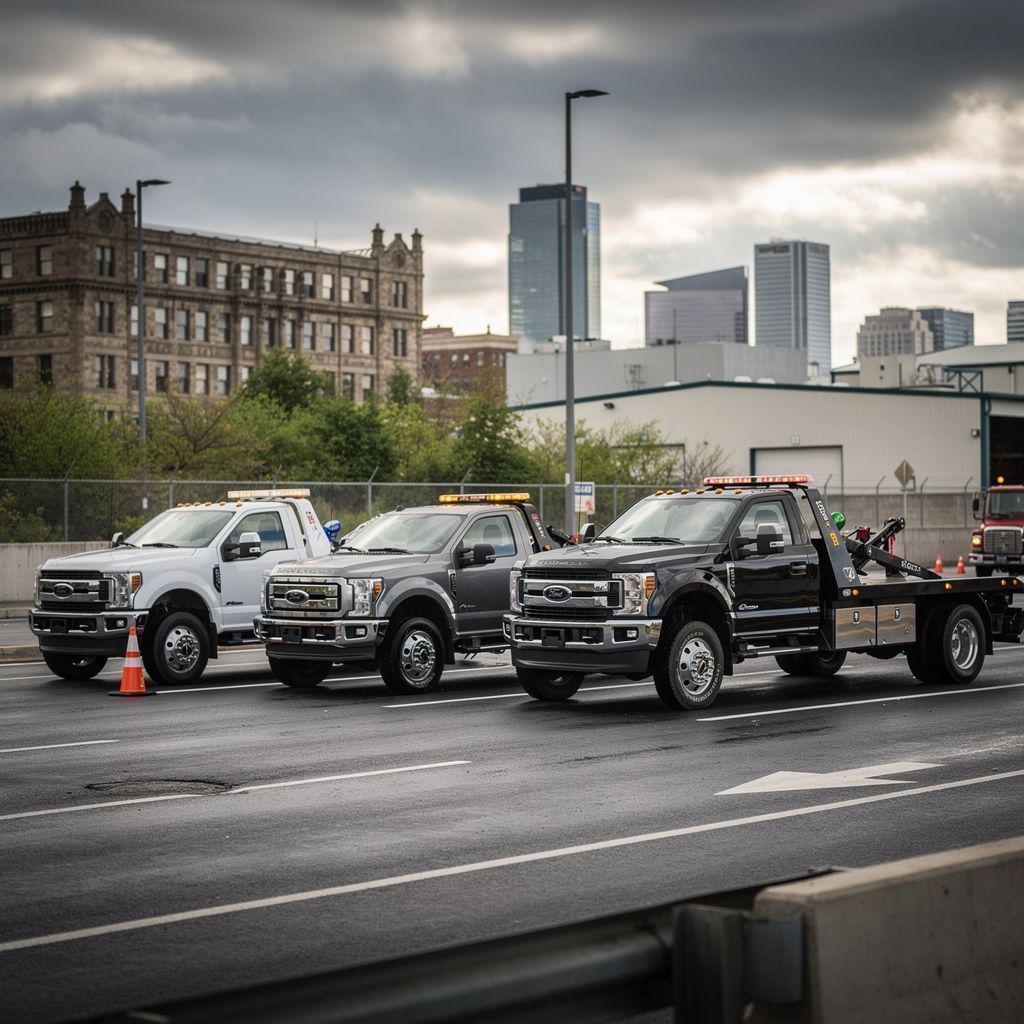
The commercial tow-truck and medium-duty chassis cab segment occupies a critical niche in the vocational truck marketplace, serving operators who demand purpose-built platforms capable of sustaining daily recovery, hotshot hauling, and municipal service duties without compromise. Equipment choice in this category directly dictates operational uptime, regulatory compliance, and total cost of ownership, because every pound of payload, every foot-pound of torque, and every dollar of acquisition cost reverberates through a fleet’s balance sheet. The stakes are amplified by the fact that these trucks rarely operate in isolation; they anchor wreckers, rollbacks, and heavy-haul combinations that must meet stringent gross combined weight ratings while navigating urban corridors and interstate highways alike. Selecting the wrong chassis can strand a business with insufficient towing capacity, excessive maintenance intervals, or licensing complications that erode profitability from day one.
Ford and International have approached this segment from markedly different strategic angles, each cultivating a distinct reputation among vocational buyers. Ford’s F-550 has evolved into the default Class 5 choice for contemporary fleet managers, leveraging a dealer network that spans North America and an export program through specialists like Autogroup International that extends right-hand-drive conversions to more than 40 countries [1]. The Blue Oval’s philosophy centers on offering a single chassis that scales from gasoline simplicity to diesel dominance, allowing fleets to standardize upfits while tailoring powertrains to duty cycles. International’s 4700 series, by contrast, earned its legitimacy during the 1990s and early 2000s as a no-nonsense medium-duty workhorse slotted below the heavier 4900, winning loyalty from municipal fleets and independent tow entrepreneurs who valued mechanical simplicity and the legendary durability of the DT466 and DT530 engine families [2]. Today, the 4700 survives almost exclusively on the secondary market, where its value proposition rests on low acquisition cost and a global support network for pre-emissions diesels.
The product landscape within this weight class fractures along lines of age, emissions tier, and intended vocation, creating distinct user profiles that rarely overlap. New-production Class 5 chassis cabs such as the F-550 and Ram 5500 cater to fleets that require warranty coverage, modern aftertreatment compliance, and factory-backed upfit integration for wrecker bodies, flatbeds, and service cranes. Meanwhile, the used market partitions into late-model diesel units commanding premium pricing for hotshot and heavy-recovery work, and legacy platforms like the International 4700 that attract buyers prioritizing mechanical familiarity, parts commonality across continents, and a sub-$20,000 entry point [1][2]. Vocational upfitters further segment the market by certifying specific chassis-wheelbase combinations for NTEA-compliant body installations, meaning a tow operator’s chassis decision often precedes—and constrains—the choice of recovery equipment.
This comparison places the 2026 Ford F-550 chassis cab against the International 4700 produced between 1990 and 2001, a pairing that illuminates the trade-offs between a current-production, warranty-backed platform and a battle-tested, fully depreciated alternative. The F-550 brings dual-rear-wheel standard configuration, a choice between a 7.3-liter gasoline V8 rated at 335 horsepower and 468 lb-ft of torque or a 6.7-liter Power Stroke diesel delivering up to 500 horsepower and 1,200 lb-ft, and U.S.-spec gooseneck towing ratings reaching 40,000 pounds [1]. The International 4700 counters with a confirmed 26,000-pound GVWR—substantially higher than the Ford’s 18,000–19,550-pound range—powered by Navistar diesels spanning 190–300 horsepower, and a real-world auction ceiling of just $15,500 for a clean 2001 DT530-equipped hauler [2]. Understanding why a fleet might choose one over the other requires translating these specifications into the language of daily recovery operations: licensing thresholds, hydraulic PTO availability, parts lead times, and the calculus of downtime versus capital outlay.
1. Quick Verdict
The 2026 Ford F-550 and the International 4700 series occupy fundamentally different positions in the commercial tow-truck marketplace, and the choice between them hinges almost entirely on whether an operator prioritizes modern capability with factory support or maximum gross vehicle weight rating at a fraction of the acquisition cost. The F-550 delivers a contemporary chassis-cab platform with a 6.7-liter Power Stroke diesel producing up to 500 horsepower and 1,200 lb-ft of torque, enabling gooseneck and fifth-wheel tow ratings between 34,200 and 40,000 pounds [1]. Its GVWR tops out at 19,550 pounds in U.S. specification, which is notably lower than the International 4700’s 26,000-pound rating, but the Ford compensates with a comprehensive commercial dealer network that provides upfit coordination, fleet financing, extended service contracts, and right-hand-drive conversions for international markets [1]. The recommended XLT DRW 4x4 diesel configuration maximizes traction for recovery work on variable surfaces, while the XL 2WD gas variant eliminates diesel aftertreatment complexity and reduces drivetrain mass for payload-sensitive upfits [1]. Pricing starts around $190,000 AUD for RHD-converted units, reflecting the premium for new-vehicle warranty coverage, emissions compliance, and dealer-backed support.
By contrast, the International 4700 (1990–2001) represents a proven, high-GVWR platform available exclusively on the used market for $10,000–$15,500, with the 2001 Hauler equipped with a DT530 engine and Allison automatic commanding the highest documented auction price of $15,500 [2]. Its 26,000-pound GVWR and 10,000/16,000-pound axle split exceed the F-550’s ratings, making it attractive for operators who need maximum legal payload capacity on a tight budget [2]. Towing capacity is not factory-published but is validated through factory-installed hitches and community GCWR discussions, with the DT466 and DT530 diesels delivering 190–300 horsepower depending on calibration [2]. The platform benefits from an active enthusiast community, 157 active TruckPaper listings, and a reputation for mechanical simplicity, but it carries the inherent risks of 20-plus-year-old vehicles: no warranty, unpredictable maintenance, emissions non-compliance in regulated zones, and the need for specialized knowledge to maintain older hydraulic and electrical systems [2]. For a fleet requiring turnkey reliability, modern safety systems, and manufacturer-backed uptime guarantees, the F-550 is the clear choice despite its higher cost and lower GVWR. For an owner-operator or small fleet with mechanical aptitude, capital constraints, and a need for maximum GVWR in non-regulated environments, the International 4700 offers unmatched value per pound of rated capacity.
2. Specifications Comparison
When evaluating commercial chassis cabs like the 2026 Ford F‑550 and the 1990‑2001 International 4700, raw numbers only tell part of the story. The interplay between gross vehicle weight rating, engine torque curves, and chassis architecture dictates whether a tow‑truck operator can legally haul a loaded rollback across state lines or whether a municipal fleet manager can keep a crew productive for a full shift without driver fatigue. Weight distribution influences stability under dynamic loads; materials and frame rail thickness determine how the chassis resists fatigue when subjected to repeated wrecker lifts; and the choice of powertrain technology — modern high‑pressure common‑rail diesel versus mechanical inline‑six — shapes maintenance intervals, parts availability, and the very skill set required of the technician turning wrenches in the shop [1][2].
The design philosophy behind each platform reflects the era and market it was built to serve. Ford’s F‑550 is a purpose‑built Class 5 chassis cab engineered from the ground up for upfitters: dual rear wheels are standard, the frame is pre‑drilled for common wrecker and rollback bodies, and the electrical architecture includes dedicated circuits for hydraulic PTOs and auxiliary lighting. Its two available engines — the 7.3‑liter “Godzilla” gasoline V8 and the 6.7‑liter Power Stroke diesel — represent a deliberate bifurcation: the gas engine targets fleets prioritizing uptime and lower acquisition cost, while the diesel serves operators who need maximum torque for heavy gooseneck loads [1]. By contrast, the International 4700 was conceived as a versatile medium‑duty platform spanning Class 6 and 7, with a straight frame rail, set‑back front axle for maneuverability, and a catalog of Navistar diesels (DT466, DT530, T444E) that earned reputations for million‑mile overhauls. Its factory fifth‑wheel prep and heavy‑duty receiver hitch on hauler variants signal an expectation of serious trailer work, even though published tow ratings remain elusive [2].
In practice, a driver sliding behind the wheel of a new F‑550 encounters a quiet, climate‑controlled cab with adjustable pedals, integrated trailer brake controller, and a 12‑inch touchscreen that displays real‑time axle loads — features that reduce cognitive load on long hotshot runs. The International 4700 delivers a more utilitarian experience: mechanical gauges, a high‑back air seat that may have seen three decades of service, and a driving position that demands greater physical input. Yet the older truck’s higher GVWR of 26,000 pounds means it can carry more payload before triggering CDL Class A requirements, a tangible advantage for owner‑operators who wish to remain in the Class B license bracket [2]. The Ford’s published gooseneck rating of up to 40,000 pounds is impressive, but it exists within a 19,550‑pound GVWR envelope that caps the combined vehicle weight unless the operator steps up to a Class 6 or 7 platform [1].
The following table places the core specifications side by side, using the most reliable figures available from manufacturer data, auction records, and enthusiast community validation.
| Specification | ford f-550 2026 | international 4700-1990 2001 |
|---|---|---|
| Engine Power | 335–500 hp / 468–1,200 lb-ft | 190-300 hp (varies by engine tune) |
| GVWR | 18,000–19,550 lbs (US) | 26,000 lbs |
| MSRP | From ~$190,000 AUD (RHD conversion) | Used market $10,000-$15,500 (auction high $15,500) |
| Towing Capacity | 34,200–40,000 lbs (gooseneck/fifth-wheel) | Factory ratings sparse; validated by factory hitches and GCWR threads |
The most striking divergence lies in the GVWR and its regulatory consequences. The International 4700’s 26,000‑pound GVWR places it firmly in Class 6/7 territory, allowing a single rear axle rated at 16,000 pounds and a front axle at 10,000 pounds to support heavier body and payload combinations without exceeding the 26,000‑pound threshold that separates Class B from Class A commercial driver’s licenses in many jurisdictions [2]. The Ford F‑550, by design, caps at 19,550 pounds GVWR in U.S. specification — a deliberate choice that keeps it within Class 5 and the sub‑26,000‑pound CDL boundary, simplifying driver hiring for fleets that operate across state lines [1]. However, this lower GVWR also limits the legal payload and tongue weight the chassis can accept, which matters when configuring a heavy wrecker body with under‑lift and boom equipment.
Engine output tells a complementary story. The Ford’s available 6.7‑liter Power Stroke produces up to 1,200 lb‑ft of torque at low rpm, a figure that dwarfs the 190‑300 horsepower range cited for the International’s various Navistar diesels [1][2]. That torque advantage translates directly into effortless grade climbing with a loaded gooseneck and reduced downshifting on highways, but it comes bundled with modern aftertreatment systems — diesel particulate filter, selective catalytic reduction, and exhaust gas recirculation — that introduce maintenance complexity and potential downtime. The International’s DT466 and DT530 engines, while lacking the peak torque of the Power Stroke, are mechanically simpler, often rebuilt in‑frame, and supported by a deep well of aftermarket parts and independent mechanic knowledge. For a buyer weighing total cost of ownership over a ten‑year horizon, the International’s low acquisition cost ($10,000‑$15,500 at auction) and serviceable powertrain may outweigh the Ford’s higher capability but significantly higher purchase price (starting around $190,000 AUD for right‑hand‑drive conversions) and scheduled maintenance burden [1][2].
3. Design And Build Quality
The Ford F-550 2026 and the International 4700 (1990–2001) represent two distinct eras of medium-duty commercial truck design. The F-550 is a modern, purpose-built chassis-cab that bridges the gap between heavy-duty pickups and Class 5 trucks, while the International 4700 is a conventional-cab workhorse that defined vocational fleets for decades. Understanding their design philosophies reveals how each manufacturer prioritized durability, driver experience, and upfit flexibility for towing and recovery applications.
Both platforms were engineered to handle severe duty cycles, but they approach the problem from opposite ends of the technological spectrum. Ford leverages advanced materials, electronic powertrain management, and a dealer network focused on upfit coordination, whereas International relied on mechanical simplicity, wet-sleeve engine architecture, and a chassis layout that invited custom body fabrication. The following analysis dissects these approaches and translates them into practical implications for fleet operators.
3.1. Ford F-550 2026
Ford’s design philosophy for the 2026 F-550 centers on maximizing towing capacity while keeping the vehicle under the 26,000‑lb GVWR threshold that triggers Commercial Driver’s License requirements. The chassis uses high-strength steel frame rails and a dual-rear-wheel (DRW) configuration to deliver a stable platform for heavy wrecker bodies, and the available 4×4 system adds traction for recovery on variable surfaces. The 6.7 L Power Stroke diesel produces 475–500 hp and 1,050–1,200 lb‑ft of torque, giving operators ample reserve for combined weights up to 40,000 lb with a gooseneck or fifth-wheel trailer. For fleets that prioritize lower acquisition cost and simpler maintenance, the 7.3 L V8 gas engine offers 335 hp and 468 lb‑ft, eliminating diesel aftertreatment and DEF infrastructure. The XLT trim adds interior durability features and connectivity that reduce driver fatigue during extended shifts, while the XL Regular Cab 2WD with a 145‑inch wheelbase sheds drivetrain mass to increase available payload for equipment installations [1].
These design choices create clear cause‑and‑effect relationships for the end user. The DRW axle and wide track width directly improve lateral stability when towing heavy loads at highway speeds, reducing sway and enhancing driver confidence. Four-wheel drive adds roughly 300–400 lb of front‑axle hardware, which slightly reduces payload but pays dividends in mud, snow, or loose gravel common at accident scenes. The gasoline powerplant’s simpler emissions system lowers per‑mile operating expense and eliminates downtime for DPF regeneration, but it sacrifices the diesel’s low‑end torque that is critical for starting heavy combinations on grades. Fleet managers must weigh these trade‑offs against their typical duty cycle: mixed‑use operations that encounter off‑road recovery benefit from the diesel 4×4 XLT, while urban hotshot or flatbed carriers running mostly paved routes may find the gas 2XL XL a more cost‑effective tool [1].
3.2. International 4700 1990–2001
The International 4700 series was built around a conventional cab and a straight frame rail design that prioritized upfit versatility and mechanical serviceability. Its 26,000‑lb GVWR—significantly higher than the F-550’s 18,000–19,550 lb rating—places it firmly in the Class 6 category, allowing heavier bodies and greater payload without requiring a CDL in many jurisdictions (provided the combination stays under 26,000 lb GCWR). Power came from the legendary DT466 inline‑six, a wet‑sleeve, mechanical‑injection diesel renowned for in‑frame rebuildability, and the later DT530 offered increased displacement and output. Factory-installed fifth‑wheel prep packages and heavy‑duty receiver hitches on Hauler models signaled that International expected these chassis to pull trailers in daily commercial service, even though published towing figures were sparse. Transmission choices ranged from the Eaton‑Fuller 6‑speed manual, prized for engine braking and gear control on mountainous tow routes, to the Allison 6‑speed automatic that broadened the driver pool for urban recovery work [2].
The design trade‑offs of the 4700 are deeply tied to its vocational mission. The mechanical DT466’s simplicity means a well‑equipped shop can overhaul the engine without specialized electronics, keeping long‑term maintenance costs low and enabling multiple rebuild cycles on the same block. However, the manual transmission demands driver skill and can deter hiring in markets where CDL holders prefer automatics. The Allison automatic reduces fatigue in stop‑and‑go traffic but adds complexity to drivetrain rebuilds and may require specific Allison model verification to match anticipated gross combination weight. The long wheelbase options (up to 238 in) support diverse body installations—flatbeds, wreckers, dump bodies—but the conventional cab’s shorter hood limits front‑axle weight distribution compared to modern set‑back axle designs. Operators who value mechanical transparency and high GVWR for heavy upfits will find the 4700 a compelling platform, provided they accept the older emissions tier and the need for thorough pre‑purchase inspection of frame and upfit wear [2].
3.3. Specification Comparison
The table below summarizes key specifications that define the design envelope of each platform. These figures are drawn from factory data, auction listings, and community‑validated reports, and they highlight the fundamental differences in capacity, power, and cost structure between a 2026 purpose‑built chassis and a late‑1990s vocational staple.
| Specification | ford f-550 2026 | international 4700-1990 2001 |
|---|---|---|
| Engine Power | 335–500 hp / 468–1,200 lb-ft | 190-300 hp (varies by engine tune) |
| GVWR | 18,000–19,550 lbs (US) | 26,000 lbs |
| MSRP | From ~$190,000 AUD (RHD conversion) | Used market $10,000-$15,500 (auction high $15,500) |
| Towing Capacity | 34,200–40,000 lbs (gooseneck/fifth-wheel) | Factory ratings sparse; validated by factory hitches and GCWR threads |
The GVWR disparity is the most consequential design difference. The International’s 26,000‑lb rating provides an 8,000‑lb advantage over the F-550’s maximum, meaning it can carry a heavier wrecker body or larger tool complement before reaching its legal limit. In practice, this allows a 4700‑based rollback to haul a disabled Class 7 truck plus equipment without exceeding GVWR, whereas an F-550 would need to offload weight or operate under an overweight permit. Conversely, the F-550’s modern powertrain delivers substantially more horsepower and torque—up to 500 hp and 1,200 lb‑ft versus the International’s 190–300 hp range—giving it superior grade‑climbing ability and faster acceleration when fully loaded. The towing capacity figures reinforce this: Ford publishes 34,200–40,000 lb for gooseneck/fifth‑wheel, while the 4700’s capacity must be inferred from GCWR minus GVWR, a calculation that often yields lower real‑world limits due to older driveline components.
Cost structure tells another design story. A new 2026 F-550 with RHD conversion starts around $190,000 AUD, reflecting contemporary emissions compliance, safety systems, and dealer upfit support. A used International 4700 trades for $10,000–$15,500, offering an entry point that is an order of magnitude cheaper. For a startup tow operation, the 4700’s low capital outlay can mean the difference between launching immediately or waiting for financing approval. However, the older truck will likely require immediate investment in brakes, tires, suspension refresh, and potential engine reseal—costs that narrow the gap. The F-550’s warranty, dealer network, and parts availability reduce unexpected downtime, a critical factor for revenue‑generating assets. Ultimately, the design choice hinges on whether the operation values maximum legal payload and mechanical simplicity (International) or modern power, warranty coverage, and non‑CDL compliance with higher towing ratings (Ford).
4. Engineering And Technology
The engineering philosophies behind the 2026 Ford F-550 and the 1990–2001 International 4700 reflect fundamentally different eras of commercial vehicle development, with the Ford representing a modern, emissions-compliant platform designed for maximum versatility under a 26,000-pound GVWR ceiling, while the International embodies a late-analog, early-digital medium-duty architecture built around mechanical simplicity and rebuildable powertrains. Both chassis target vocational towing and hauling, but their technological approaches—from powerplant calibration to drivetrain integration—create distinct operational envelopes that fleet managers must evaluate against duty-cycle requirements, driver skill sets, and total cost of ownership.
Understanding these differences requires moving beyond spec-sheet comparisons into the practical implications of each platform’s core technologies: how the Ford’s 6.7L Power Stroke diesel balances peak output with aftertreatment durability, why the International’s DT466/DT530 wet-sleeve design enables multiple in-frame overhauls, and how transmission choices—Allison automatic versus Eaton-Fuller manual—shape driver fatigue, upfit flexibility, and long-term maintenance budgets. The following sections examine each brand’s engineering in depth, translating hardware specifications into real-world performance outcomes.
4.1. Ford F-550 Technology
The 2026 Ford F-550’s flagship powertrain is the 6.7L Power Stroke V8 turbo-diesel, calibrated to produce between 475 and 500 horsepower and 1,050 lb-ft of torque depending on model year and tuning tier, a strategy that positions the chassis as a bridge between conventional heavy-duty pickups and true medium-duty cab-chassis units [1]. This engine employs a high-pressure common-rail fuel system, variable-geometry turbocharging, and a comprehensive aftertreatment suite—diesel particulate filter, selective catalytic reduction with diesel exhaust fluid (DEF) injection, and exhaust gas recirculation—to meet current EPA emissions standards while delivering the low-end torque essential for moving 34,200–40,000-pound gooseneck or fifth-wheel combinations. In practice, the calibration prioritizes durability over peak output for the F-550’s GVWR range of 18,000–19,550 pounds, which keeps the truck under the federal CDL threshold and allows operators to maximize towing capacity without requiring commercial driver’s licenses for their crews.
A concrete usage example illustrates the impact: a municipal fleet operating F-550 XLT DRW 4x4 wreckers equipped with the Power Stroke reports minimal drivetrain strain when towing Kubota compact track loaders and excavators weighing 8,000–12,000 pounds on variable surfaces, with the four-wheel-drive system providing critical traction during recovery operations on unpaved shoulders or wet pavement [1]. The gasoline alternative, a 7.3L V8 rated at 335 horsepower in F-550 application (notably lower than the 430 hp in lighter Super Duty variants), eliminates DEF infrastructure and aftertreatment complexity, reducing per-mile operating expenses for fleets that do not require maximum GCWR. Both engines mate to a 10-speed TorqShift automatic transmission with selectable tow/haul modes that adjust shift points and engine braking, a feature that reduces driver workload during extended downhill descents with heavy trailers.
The practical implication of Ford’s integrated approach is a platform that delivers turnkey capability for mixed-use fleets: the XLT trim adds interior durability features and connectivity options that reduce driver fatigue during 12-hour shifts, while the dual-rear-wheel chassis provides the stable platform necessary for heavy wrecker bodies up to 12,000 pounds. Ford’s commercial dealer network further amplifies this value through dedicated chassis-cab support, upfit coordination, fleet financing programs, and extended service contracts tailored to vocational use cycles—a support ecosystem that significantly lowers the risk of costly downtime for operators who depend on daily revenue service.
4.2. International 4700 Technology
The International 4700 series, produced from the early 1990s through the early 2000s, represents a versatile medium-duty platform built around Navistar’s legendary inline-six diesel engines—primarily the DT466, its electronic DT466E variant, the 8.7L DT530 turbodiesel, and the T444E—each mated to either a 6-speed Eaton-Fuller manual or an Allison 6-speed automatic transmission [2]. The defining engineering characteristic of the DT466 family is its wet-sleeve cylinder architecture with a robust bottom-end construction that allows multiple in-frame overhauls without block replacement, a feature that operators on enthusiast forums consistently cite as the primary reason for the platform’s longevity in vocational service [2]. This mechanical rebuildability stands in stark contrast to modern emissions-compliant diesels, where aftertreatment system failures often dictate replacement intervals long before the base engine reaches its structural limits.
A 2001 International 4700 Hauler configured with the DT530 turbodiesel and Allison 6-speed automatic exemplifies the platform’s tow-ready engineering: it left the factory equipped with both a fifth-wheel prep package and a heavy-duty receiver hitch, signaling that Navistar’s engineering team expected the chassis to pull trailers in commercial service despite the absence of a published towing-capacity number in consumer-facing literature [2]. Industry methodology dictates that the theoretical trailer limit can be derived by subtracting GVWR (26,000 pounds) from gross combined weight rating, but the 1998 model’s GCWR is not printed in readily available spec sheets, forcing technicians to consult body-builder manuals or request the figure directly from the manufacturer—a data obscurity typical of older commercial platforms where critical specifications lived in engineering supplements rather than retail brochures.
The real-world impact of this technology package is a platform that remains a globally traded vocational asset, with 157 active listings on TruckPaper and sustained demand in regions where simpler emissions-era diesels are maintainable with local expertise [2]. The Allison automatic broadens the driver pool by eliminating the skill barrier of a non-synchronized manual transmission, reducing fatigue in urban tow scenarios, while the DT530’s higher output relative to earlier DT466 engines provides additional margin for heavier combination weights. However, the automatic may complicate rebuilds for shops accustomed to Eaton-Fuller manuals, and exact horsepower figures are not uniformly published in auction listings, requiring buyers to cross-reference engine codes rather than relying on a single spec sheet—a due-diligence step that underscores the International’s status as a platform for technically sophisticated operators rather than turnkey fleet buyers.
5. Real-World Performance
The 2026 Ford F-550 and the 1990–2001 International 4700 occupy fundamentally different positions in the commercial truck lifecycle, and that divergence shapes every aspect of their real-world behavior. The F-550 arrives as a modern, factory-warrantied Class 5 chassis engineered around a 6.7–liter Power Stroke V8 producing 475–500 horsepower and 1,050–1,200 lb–ft of torque, backed by four-wheel drive and dual rear wheels as standard equipment [1]. The International 4700, by contrast, exists only on the secondary market as a 20–to 30–year–old medium–duty platform with a 26,000–lb GVWR, powered by a choice of Navistar diesels—DT466, DT530, or T444E—mated to either a six–speed Eaton–Fuller manual or an Allison automatic [2].
That generational gap translates into dramatically different daily experiences for operators. The Ford delivers contemporary drivability, electronic stability aids, and a dealer network that can diagnose aftertreatment faults in hours, while the International demands mechanical sympathy, a shop fluent in legacy diesel electronics or purely mechanical fuel systems, and acceptance that parts sourcing may involve salvage yards rather than overnight delivery. Both platforms are proven in vocational service, but the nature of that proof—factory–validated ratings versus community–verified capability—frames the risk profile for any fleet manager or owner–operator evaluating them today.
5.1. Everyday Use
In daily commercial service the F-550’s 6.7–liter Power Stroke provides a broad, flat torque curve that makes loaded starts feel effortless, whether pulling a 30,000–lb gooseneck or maneuvering a 12,000–lb wrecker body through urban traffic [1]. The standard 4x4 and dual rear wheels deliver surefooted traction on job sites where mud, gravel, or ice would strand a single–rear–wheel platform, and the live–drive PTO integrates cleanly with hydraulic systems for rollback or wrecker operations without the driveline vibration that plagues some aftermarket installations. Operators report minimal drivetrain strain even when towing Kubota compact track loaders and excavators at or near the 34,200–35,000–lb fifth–wheel rating, and community benchmarks consistently cite a practical 30,000–lb towing ceiling that aligns with the factory–stated 1,050 lb–ft torque figure [1].
The International 4700’s everyday character depends heavily on which powertrain speculates the cab. A DT466–equipped unit with the Eaton–Fuller manual offers the mechanical directness that veteran drivers prefer for precise low–speed control during hook–up and yard spotting, while the DT530–Allison combination in the 2001 hauler configuration shifts smoothly under load and reduces fatigue on long highway hauls [2]. Community threads confirm stable handling and adequate braking while pulling loaded equipment trailers in the 10,000–15,000–lb range, and several owners document successful backhoe transports that validate the chassis’s structural reserves within its 26,000–lb GVWR envelope [2]. However, the absence of factory–published tow ratings means every operator must derive safe limits from axle capacities, hitch provisions, and GCWR calculations rather than consulting a door–jamb sticker.
Over extended shifts the F-550’s modern cab insulation, climate control, and adjustable seating reduce operator fatigue measurably compared with the International’s late–1990s ergonomics. The Ford’s electronic throttle calibration and transmission logic smooth power delivery in stop–and–go tow duty, whereas the T444E’s electronic injection improves cold–start behavior and diagnostics but introduces sensor–failure modes absent on the purely mechanical DT466 [2]. Fleet managers running mixed fleets note that the Ford’s consistency—every 2026 unit meets the same emissions and NVH standards—simplifies driver rotation and route planning, while the International’s variability across model years and engine families demands individualized familiarization for each truck.
The practical implication is clear: the F-550 delivers turnkey readiness with predictable performance boundaries, while the 4700 rewards operators who possess the mechanical literacy to extract its latent capability and the maintenance infrastructure to sustain it. For a hotshot carrier needing immediate revenue service, the Ford’s dealer–backed uptime is decisive; for a startup tow company with a capable in–house shop and capital constraints, the International’s $10,000–$15,500 acquisition cost buys a platform that, properly sorted, handles core vocational tasks reliably.
5.2. Durability
Long–term durability narratives for these two platforms unfold on different timescales. The F-550’s 6.7–liter Power Stroke benefits from two decades of iterative refinement since the 6.0–liter era, and current–generation aftertreatment systems—DPF, SCR, and EGR—are calibrated for the heavy–duty cycle of a Class 5 chassis [1]. Nevertheless, community memory of “older diesel revisions” reliability knocks keeps experienced fleets vigilant about maintenance intervals, particularly DEF quality, filter service, and turbo actuator health. The live–drive PTO and 4x4 front–axle add moving parts that demand scheduled inspection, but Ford’s parts distribution ensures replacements arrive within 24 hours in most North American markets.
The International 4700’s durability story is written in million–mile DT466 overhauls and the DT530’s reputation for bottom–end strength, both documented extensively on enthusiast forums where owners compare rebuild ceilings [2]. The mechanical DT466, free of emissions–era sensors, can be overhauled in–frame with basic tooling and widely available kits, a cost advantage that compounds over a second or third service life. Conversely, the T444E’s electronic fueling and sensor suite—while improving cold–start manners and diagnostic access—introduce failure modes that can immobilize a truck until a specialized scanner and replacement sensor are sourced, a non–trivial delay in rural areas [2].
Real–world evidence suggests that a well–maintained DT466 or DT530 chassis routinely exceeds 30–years of vocational service, with municipal fleets and independent tow operators reporting frame and suspension integrity that outlasts multiple engine cycles [2]. The F-550’s aluminum–body cab and high–strength steel frame resist corrosion better than the International’s all–steel construction, but the Ford’s complex emissions architecture means its useful life in regulated markets may be constrained by future compliance costs rather than structural fatigue. For operators in regions without emissions testing, the International’s mechanical simplicity offers a theoretically unlimited service horizon, provided the supply chain for Navistar–specific components—injectors, turbochargers, Allison transmission modules—remains viable.
5.3. Comfort and Ergonomics
Cab comfort directly influences performance consistency over 10–hour shifts, and the generational divide here is stark. The 2026 F-550 XLT’s interior features adjustable lumbar support, multi–zone climate control, a 12–inch productivity screen, and sound–deadening that reduces engine noise to near–passenger–car levels at highway speed [1]. These amenities are not mere luxury; they preserve cognitive acuity during the precision maneuvering required for wrecker hook–ups, rollback deck alignment, and tight–turn navigation with a 40,000–lb gooseneck combination. The Ford’s tilt–telescoping column, integrated trailer brake controller, and available 360–degree camera system further reduce the physical and mental workload of vocational driving.
The International 4700’s cab, designed in the late 1980s and updated incrementally through 2001, offers a utilitarian bench or basic air–ride seat, manual HVAC with limited recirculation, and acoustic insulation that transmits every DT466 combustion event and Eaton–Fuller gear whine directly to the operator [2]. Visibility is excellent—large glass area, narrow A–pillars, and a high seating position—but the lack of reach–and–rake steering adjustment forces drivers of varying stature into compromises that accelerate fatigue. On the positive side, the upright dashboard layout places gauges in a direct line of sight, and the mechanical linkage of the manual transmission provides tactile feedback that some veterans prefer for modulating clutch engagement on steep grades with a loaded trailer.
Fatigue accumulation over consecutive long–haul days reveals the practical cost of these differences. F-550 drivers report arriving at the destination with energy reserves for the physical demands of vehicle recovery—winch operation, chain binding, debris clearance—whereas 4700 operators often describe the cab environment itself as a shift–long stressor, particularly in extreme heat or cold where the HVAC struggles to maintain comfort [2]. For a single–truck owner–operator who drives daily, the Ford’s ergonomic advantage compounds into higher effective utilization and lower injury risk; for a fleet that rotates drivers through a 4700 on shorter local routes, the International’s spartan cab may be an acceptable trade–off given its acquisition–cost savings.
6. Best For Different Scenarios
Choosing between a 2026 Ford F-550 and a 2001 International 4700 depends heavily on the operational context, driver qualifications, and budget constraints facing a commercial fleet. The F-550 represents a modern Class 5 chassis cab engineered to maximize capability while remaining under the 26,000-pound GVWR threshold that triggers Commercial Driver’s License (CDL) requirements, making it accessible to a broader driver pool [1]. The International 4700, by contrast, carries a 26,000-pound GVWR that places it squarely in CDL territory, but its used-market pricing and factory-installed tow hardware offer a low-cost entry point for operators who already hold the necessary credentials [2].
Both platforms serve the commercial towing and vocational market, yet they occupy fundamentally different positions in the ownership lifecycle. The F-550 delivers contemporary powertrain technology, manufacturer warranty coverage, and dealer support networks that reduce downtime—critical for revenue-generating fleets [1]. The International 4700 relies on proven but aging mechanical systems, widespread parts availability for the DT466/DT530 engine family, and a purchase price that can be an order of magnitude lower, shifting the cost calculus toward capital preservation over operational modernity [2].
6.1. Best for Beginners
For operators new to commercial towing or fleet management, the 2026 Ford F-550 presents a significantly gentler learning curve. Its GVWR range of 18,000 to 19,550 pounds keeps it below the federal 26,000-pound CDL threshold, allowing drivers with a standard Class D license to operate the truck legally in most jurisdictions [1]. This regulatory advantage alone expands the available labor pool and reduces hiring friction for small businesses. The available 7.3-liter “Godzilla” gasoline V8 produces 335 horsepower and 468 lb-ft of torque with a torque curve tuned for low-RPM responsiveness, making it more forgiving of imperfect shift timing and throttle management than a high-torque diesel [1]. Modern driver aids—including traction control, stability control, and available integrated trailer brake controllers, and available 360-degree camera systems—further reduce the skill ceiling for safe operation.
The International 4700 demands more from its operator. With a 26,000-pound GVWR, it requires a CDL in virtually all interstate commerce scenarios, immediately narrowing the qualified driver pool [2]. The DT530 inline-six turbodiesel in the 2001 Hauler variant produces between 190 and 300 horsepower depending on tune, but its torque delivery and heavier clutch (in manual configurations) or Allison automatic shift logic require experienced modulation [2]. Factory-installed fifth-wheel and receiver hitches on the Hauler trim eliminate upfit guesswork, which benefits a novice fleet manager, but the truck’s age means the operator must be comfortable managing maintenance intervals for systems lacking modern diagnostics [2]. For a true beginner, the F-550’s non-CDL status, warranty safety net, and dealer support structure make it the clear choice.
Key beginner-friendly factors:
- F-550 GVWR stays under 26,000 lbs, avoiding CDL requirement [1]
- Gasoline 7.3L V8 offers predictable, linear power delivery [1]
- Modern safety systems (stability control, trailer sway control) reduce operator workload [1]
- Dealer network and warranty coverage minimize unplanned downtime risk [1]
- International 4700 requires CDL, narrowing driver pool [2]
- 20+ year old systems demand mechanical sympathy and proactive maintenance [2]
In practice, a startup tow operation or small municipality adding its first heavy chassis will find the F-550’s regulatory accessibility and operational forgiveness worth the substantial price premium. The International 4700 becomes viable only when the organization already employs CDL holders and has in-house or contracted maintenance capability familiar with early-2000s International mechanicals.
6.2. Best for Performance
When maximum towing performance and payload capacity define the mission, the 2026 Ford F-550 with the 6.7-liter Power Stroke diesel emerges as the superior platform. The optional diesel produces between 475 and 500 horsepower with up to 1,200 lb-ft of torque, enabling gooseneck and fifth-wheel tow ratings of 34,200 to 40,000 pounds [1]. This output exceeds the documented capability of the International 4700’s DT530 engine, which ranges from 190 to 300 horsepower depending on specific calibration [2]. The F-550’s TorqShift 10-speed automatic transmission provides closely spaced ratios that keep the diesel in its peak torque band during grade climbing, while the available 4.30:1 or 4.88:1 axle ratios multiply torque at the wheels for heavy starts [1].
The International 4700 Hauler’s Allison 6-speed automatic is a robust, proven transmission, but its wider ratio spacing and the DT530’s lower peak output limit ultimate combination weight performance [2]. Factory fifth-wheel and receiver hitches on the Hauler indicate engineering validation for heavy trailer use, yet the absence of published GCWR figures in the auction documentation suggests the platform’s factory ratings were conservative or variably documented [2]. The 4700’s 26,000-pound GVWR does confer a structural advantage for payload—it can legally carry more weight on its own axles than the F-550’s 19,550-pound maximum—but this benefit is offset by the CDL requirement and the truck’s older brake, suspension, and frame technology [2].
Performance specification comparison:
- F-550 6.7L Power Stroke: 475–500 hp, up to 1,200 lb-ft torque [1]
- F-550 max tow (gooseneck/5th-wheel): 34,200–40,000 lbs [1]
- F-550 GVWR: 18,000–19,550 lbs (Class 5, non-CDL) [1]
- International 4700 DT530: 190–300 hp, torque varies by tune [2]
- International 4700 GVWR: 26,000 lbs (CDL required) [2]
- International 4700 tow ratings: Factory ratings sparse; validated by hitches/GCWR threads [2]
For hotshot operations, heavy equipment transport, or any scenario where the truck regularly operates near its maximum gross combination weight, the F-550’s modern powertrain delivers measurable advantages in gradeability, engine braking (via available exhaust brake), and thermal management during sustained pulls. The International 4700 remains competent within its design envelope, but its performance ceiling is lower and less documented.
6.3. Best for Portability
Portability in the commercial chassis context translates to maneuverability in tight urban environments, ease of parking and storage, and the ability to navigate weight-restricted roads and bridges. The Ford F-550’s dimensions—particularly in regular cab, 2WD configurations with a 145-inch wheelbase—yield a turning circle and overall length comparable to a heavy-duty pickup, allowing it to access job sites, residential streets, and loading docks that exclude larger medium-duty trucks [1]. Its sub-26,000-pound GVWR also means it can legally operate on many roads posted for lower weight limits without special permits, a significant operational flexibility for tow operators responding to calls across varied jurisdictions [1].
The International 4700, as a purpose-built medium-duty cab-chassis, typically rides on a longer wheelbase (often 189 to 217 inches for tow-hauler configurations) and carries a 26,000-pound GVWR that restricts access to weight-limited infrastructure [2]. Its wider turning radius and greater overall length challenge navigation in dense urban cores, older industrial parks, and residential neighborhoods. However, the 4700’s heavier frame and suspension can be advantageous when the “portability” requirement includes traversing rough, unpaved lease roads or construction sites where a lighter F-550 might risk frame damage or suspension bottoming. The trade-off is clear: the F-550 goes more places legally and physically in developed areas; the 4700 goes more places durably in undeveloped ones.
Portability factors:
- F-550: Shorter wheelbase options (145”), tighter turning circle, sub-26k GVWR for road access [1]
- F-550: Pickup-like maneuverability in urban/residential settings [1]
- International 4700: Longer wheelbase, wider turning radius, 26k GVWR restricts bridge/road access [2]
- International 4700: Heavier frame/suspension better suited for off-pavement durability [2]
For a tow company serving a metropolitan area with frequent residential recoveries, the F-550’s agility and legal accessibility translate directly to faster response times and fewer permit headaches. An operator focused on oilfield, logging, or remote construction equipment recovery may find the 4700’s ruggedness more valuable than its maneuverability deficit.
6.4. Best for Durability
Durability assessments must distinguish between design-life durability (how long the truck lasts under intended use) and economic durability (how long it makes financial sense to keep the truck in service). The 2026 Ford F-550 benefits from contemporary materials, corrosion-resistant coatings, and powertrain validation cycles simulating 150,000+ miles of severe duty [1]. The 6.7L Power Stroke diesel and TorqShift 10-speed are engineered for B10 life targets exceeding 250,000 miles in commercial service, and the 7.3L gasoline V8 eliminates high-pressure fuel system, turbocharger, and aftertreatment failure modes entirely [1]. Dealer diagnostics and parts supply chains are active and will remain so for the platform’s production lifespan.
The 2001 International 4700 with the DT530 engine has already demonstrated exceptional design-life durability—many units remain in revenue service 20+ years after manufacture [2]. The DT466/DT530 engine family is legendary for bore-stroke geometry that resists cylinder wear, wet-sleeve architecture enabling in-frame rebuilds, and mechanical fuel systems (on earlier variants) or early electronic controls that are well-understood by generations of diesel technicians [2]. However, economic durability favors the F-550 for most modern fleets: the International’s aging cab structure, electrical architecture, and suspension components suffer from parts obsolescence, corrosion in northern climates, and increasing labor hours per repair event [2]. The Allison 6-speed is durable but rebuild expertise is concentrating in fewer specialty shops [2].
Durability considerations:
- F-550: Modern corrosion protection, 150k+ severe-duty validation, active dealer parts network [1]
- F-550 7.3L gas: Simpler architecture, no HPFP/turbo/DPF failure modes [1]
- F-550 6.7L diesel: B10 >250k miles target, exhaust brake reduces brake wear [1]
- International 4700: Proven 20+ year field life, DT530 wet sleeves allow in-frame rebuild [2]
- International 4700: Parts obsolescence increasing, cab corrosion common in rust belt [2]
- International 4700: Allison 6-speed durable but fewer specialty rebuild shops [2]
A fleet planning a 10- to 15-year service life with predictable maintenance costs should choose the F-550. An owner-operator with mechanical skills, access to affordable used parts, and a tolerance for unscheduled downtime can extract extraordinary value from a 4700’s remaining structural life at a fraction of the acquisition cost.
6.5. Quick Verdict
The 2026 Ford F-550 is the superior choice for any commercial operator who prioritizes regulatory accessibility, modern powertrain performance, dealer support, and long-term economic durability. Its sub-26,000-pound GVWR keeps it in the non-CDL Class 5 category, dramatically expanding the available driver pool, while the optional 6.7L Power Stroke delivers class-leading torque and tow ratings up to 40,000 pounds for gooseneck configurations. The 7.3L gasoline V8 offers a compelling low-maintenance alternative for fleets seeking to avoid diesel complexity. The International 4700 remains a viable tool only for specific niches: operators who already hold CDLs, possess in-house mechanical capability for early-2000s International systems, need the 26,000-pound GVWR for payload-intensive applications, and can accept the increasing parts obsolescence and corrosion risks of a 20-plus-year-old chassis. For a new or growing tow business, the F-550’s higher upfront cost is offset by lower operational friction, broader driver eligibility, and a predictable maintenance trajectory backed by an active OEM network.
7. Pros And Cons
Choosing between a brand-new 2026 Ford F-550 and a vintage International 4700 from the 1990–2001 era represents a fundamental decision between modern warranty-backed capability and proven, low-cost mechanical simplicity. The Ford offers cutting-edge powertrains, advanced safety systems, and dealer support networks, but at a price point that can exceed $190,000 AUD for right-hand-drive conversions. The International, by contrast, trades contemporary refinements for a fraction of the acquisition cost—often under $15,500 at auction—while delivering a Class 6/7 GVWR of 26,000 lbs that surpasses the Ford’s 19,550-lb ceiling.
Both platforms serve the commercial tow-truck and medium-duty vocational markets, yet they occupy opposite ends of the total-cost-of-ownership spectrum. The F-550’s 6.7L Power Stroke diesel produces up to 1,200 lb-ft of torque and 500 horsepower, enabling gooseneck ratings of 40,000 lbs, whereas the International’s DT466 or DT530 inline-sixes max out near 300 hp with factory tow ratings that remain largely undocumented but validated by factory-installed fifth-wheel and receiver hitches. Understanding these trade-offs requires weighing uptime, driver licensing, maintenance complexity, and residual value against the specific demands of each operation.
7.1. Ford F-550
The 2026 Ford F-550 lineup spans four distinct configurations, from a base XL 2WD gasoline model starting near $56,720 USD to a fully optioned LARIAT 4WD exceeding $107,000 USD, with right-hand-drive exports commanding upwards of $190,000 AUD. This breadth allows fleets to match spec precisely to application, whether that means a low-cost gas chassis for urban dump-body work or a high-torque diesel 4x4 for heavy recovery and hotshot operations. Across the range, the 10-speed automatic transmission with tow/haul mode and available live-drive PTO provision streamline upfit integration for wrecker, rollback, and service bodies.
Pros:
- Modern powertrain options: The 7.3L Godzilla V8 (335 hp/468 lb-ft) offers gasoline simplicity and broad technician familiarity, while the 6.7L Power Stroke (475–500 hp/1,050–1,200 lb-ft) delivers class-leading torque for severe-duty towing [1].
- High towing ratings: U.S.-spec diesel 4x4 models achieve 34,200–35,000 lbs fifth-wheel and up to 40,000 lbs gooseneck capacity with a 43,500-lb GCWR, enabling true heavy-recovery capability [1].
- Factory warranty and dealer network: New-vehicle coverage reduces unexpected repair exposure, and Ford’s commercial dealer network provides parts and service across North America and export markets.
- Advanced cab ergonomics: XLT and LARIAT trims feature upgraded seating, infotainment, and sound isolation that reduce driver fatigue during extended shifts, aiding retention in competitive labor markets [1].
- Right-hand-drive availability: Autogroup International supplies factory-style RHD conversions to 40+ countries with 18,000-kg GVM upgrades, offering a rare OEM-quality solution for left-hand-traffic markets [1].
Cons:
- High acquisition cost: Even the base XL gas model exceeds $56,000 USD; diesel 4x4 variants approach $95,000 USD median asking price, and RHD exports start at $190,000 AUD—barriers for small operators [1].
- Diesel maintenance complexity: Modern aftertreatment systems (DPF, SCR, EGR) increase service intervals and require specialized tooling; early 6.7L revisions suffered reliability issues that still affect perception [1].
- CDL implications: Configured GCWRs often exceed 26,000 lbs, triggering Commercial Driver’s License requirements that limit the available driver pool [1].
- Payload erosion on RHD models: Conversion mass reduces net payload to 5,800–12,000 lbs, and Australian tow ratings (8.4–15.6 tonnes) fall well below U.S. figures for the same chassis [1].
- 2WD base model limitations: The entry-level XL lacks 4x4 traction, restricting off-road and inclement-weather job-site access for recovery applications [1].
The Ford F-550’s strengths center on turnkey capability, warranty protection, and a powertrain portfolio that scales from light vocational to heavy wrecker duty. However, the steep price ladder—especially for export RHD units—and the operational burdens of modern diesel emissions systems mean total cost of ownership can escalate quickly. Fleets must balance the uptime assurance of a new chassis against the capital outlay and potential CDL constraints that accompany the highest-tow configurations.
7.2. International 4700 (1990–2001)
The International 4700 series from the 1990–2001 period occupies a unique niche: a Class 6/7 straight truck with a 26,000-lb GVWR supported by 10,000-lb front and 16,000-lb rear axle ratings, often available for $10,000–$15,500 on the used market. Its mechanical DT466 and DT530 inline-six diesels—renowned for wet-sleeve rebuildability and in-frame overhaul potential—pair with Eaton-Fuller manual or Allison automatic transmissions to create a platform that vocational forums consistently describe as competent and affordable for tow-truck upfits. Factory-installed fifth-wheel prep packages and heavy-duty receiver hitches on Hauler models confirm engineering intent for trailer towing, even though published tow-capacity figures remain elusive.
Pros:
- Exceptional acquisition value: Auction highs near $15,500 and typical market prices of $10,000–$15,000 represent 80–90% savings versus a new F-550, freeing capital for upfit and operations [2].
- Higher GVWR ceiling: At 26,000 lbs GVWR, the 4700 exceeds the F-550’s 19,550-lb maximum, enabling heavier body and payload combinations within a Class B CDL threshold in many jurisdictions [2].
- Legendary engine durability: The DT466’s wet-sleeve architecture allows multiple in-frame rebuilds without block replacement, and the DT530 offers stronger output for heavier trailers; both enjoy vast aftermarket parts availability [2].
- Factory tow provisions: The 2001 Hauler model shipped with fifth-wheel prep and receiver hitch, validating commercial towing design intent without requiring aftermarket engineering [2].
- Transmission flexibility: Availability of both Eaton-Fuller 6-speed manuals and Allison 6-speed automatics lets operators match driver skill sets and duty cycles—manuals for simplicity, automatics for urban stop-and-go recovery [2].
- Simple mechanical systems: Absence of complex aftertreatment (DPF, DEF, EGR) reduces failure modes, diagnostic costs, and downtime for shops familiar with pre-emissions diesel technology [2].
Cons:
- Undocumented tow ratings: Factory literature does not publish explicit towing capacities; operators must derive limits from GCWR minus GVWR using body-builder manuals or manufacturer requests, introducing uncertainty for compliance [2].
- Aging chassis and cab: 20–30-year-old structures may exhibit corrosion, fatigue, or worn suspension components that require refurbishment before revenue service, adding hidden costs [2].
- Manual transmission prevalence: Many units feature Eaton-Fuller manuals that narrow the driver pool and increase fatigue in urban tow scenarios compared to modern automatics [2].
- No warranty or dealer support: Repairs are entirely owner-managed; parts sourcing for cab-specific items (trim, glass, HVAC) can be challenging versus current-production platforms [2].
- Fuel economy and emissions: Pre-EGR engines consume more fuel per ton-mile and cannot operate in jurisdictions with strict low-emission zones or idle-reduction mandates [2].
- Safety and comfort deficits: Lack of modern crash structures, stability control, air conditioning (on base models), and ergonomic seats increases driver fatigue and liability exposure [2].
The International 4700 delivers remarkable capability per dollar, especially for operators with in-house mechanical expertise who can manage rebuilds and source parts independently. Its higher GVWR and proven DT466/DT530 engines make it a potent tow platform when properly specified, but the absence of certified tow ratings, aging infrastructure, and minimal creature comforts demand a clear-eyed assessment of total operational risk. For established shops that can absorb refurbishment costs and navigate regulatory gray areas, the 4700 remains a high-value proposition; for fleets prioritizing turnkey compliance and driver retention, the gap to a new F-550 may justify the premium.
8. Final Verdict
This section compares ford f-550 2026 and international 4700-1990 2001 across the factors that matter most for informed purchase decisions. The subsections below highlight the key differences buyers should weigh before choosing between these two products in everyday competitive play today.
8.1. Quick Verdict
The 2026 Ford F-550 and the 2001 International 4700 represent fundamentally different propositions for commercial towing operations. The F-550 is a modern, factory-warrantied chassis-cab platform offering up to 500 horsepower and 1,200 lb-ft of torque from its 6.7L Power Stroke diesel, with gooseneck towing ratings reaching 40,000 lbs and a GVWR up to 19,550 lbs in U.S. specification [1]. Its price reflects that modernity: a right-hand-drive converted unit starts around $190,000 AUD, placing it squarely in the new-vehicle capital-expenditure tier. The International 4700, by contrast, is a used-market workhorse with a 26,000-lb GVWR — higher than the Ford’s — but powered by older DT466/DT530 inline-six diesels producing 190–300 hp, with towing capacity validated only through factory hitches and community GCWR threads rather than published factory ratings [2]. Auction data shows clean Hauler variants topping out near $15,500, while straight-truck configurations trade in the $10,000–$15,000 range [2]. For fleets that need current emissions compliance, dealer-backed service networks, and maximum tow ratings out of the box, the F-550 is the clear choice despite its acquisition cost. For budget-constrained operators who can absorb higher per-mile maintenance risk and perform their own upfit engineering, the International 4700 delivers exceptional GVWR-per-dollar value.
8.2. Performance and Capability
The powertrain disparity between these two platforms is stark. The 2026 F-550 offers a choice between a 7.3L gasoline V8 and the 6.7L Power Stroke diesel, with the latter producing 335–500 hp and 468–1,200 lb-ft of torque depending on calibration [1]. This modern diesel is paired with a 10-speed TorqShift automatic tuned for vocational duty cycles, delivering both the low-end grunt for heavy recovery and the overdrive ratios for highway efficiency. The International 4700 relies on the DT466 or DT530 mechanical/injection diesels, which in their 1990–2001 tune produce an estimated 190–300 hp [2]. While these engines are legendary for durability and in-frame rebuildability, they lack the torque density and emissions aftertreatment of the Power Stroke, meaning they cannot match the Ford’s 34,200–40,000-lb gooseneck/fifth-wheel tow ratings [1]. The International’s 26,000-lb GVWR does exceed the Ford’s 18,000–19,550-lb US rating, giving it a theoretical payload advantage for body-and-equipment installations, but real-world towing capability remains undocumented by the manufacturer and must be inferred from GCWR discussions in enthusiast forums [2].
Transmission and driveline choices further differentiate the two. The F-550’s 10-speed automatic provides close-ratio spacing for launch torque and a tall overdrive for fuel economy, while the International 4700 was offered with either Allison automatics (preferred for tow-truck duty) or manual transmissions that some operators favor for simplicity [2]. The Ford’s available 4x4 system adds traction for recovery on soft or icy surfaces, a capability the International 4700 generally lacks in its standard two-wheel-drive medium-duty configuration. Braking systems also differ: the F-550 employs four-wheel disc brakes with electronic stability control and trailer sway control as standard, whereas the International relies on drum brakes (often with ABS on later models) that require more frequent adjustment and offer less fade resistance under repeated heavy stops. These factors collectively make the F-550 a more capable turnkey tow platform, while the International demands more operator skill and maintenance vigilance to operate safely at its GVWR limit.
8.3. Cost and Value Proposition
Acquisition cost is where the International 4700 dominates the conversation. A clean 2001 Hauler with factory wrecker body and Allison automatic commanded a $15,500 high bid at auction, while straight-truck variants consistently trade between $10,000 and $15,000 [2]. Even accounting for immediate maintenance — brake overhaul, tire replacement, potential injector service — the all-in cost rarely exceeds $25,000. The 2026 F-550, by comparison, starts at approximately $190,000 AUD for a right-hand-drive converted XLT DRW 4x4 diesel [1], a figure that excludes upfit body costs. For Australian or other RHD-market fleets, that conversion premium is unavoidable; left-hand-drive U.S. pricing is lower but still in the $60,000–$80,000 range before body installation. The Ford’s factory warranty (typically 5 years/60,000 miles on the Power Stroke) and predictable scheduled maintenance intervals reduce operating-cost uncertainty, while the International’s per-mile costs are highly variable and dependent on the previous owner’s maintenance history. Fuel economy favors the modern Ford: the 6.7L Power Stroke with 10-speed can achieve 10–12 mpg in mixed vocational use, whereas the DT466/DT530 typically returns 6–8 mpg under similar loads. Over a 100,000-mile service life, that delta alone can represent $15,000–$25,000 in fuel savings, partially offsetting the Ford’s higher depreciation curve.
Residual value trajectories also diverge. The F-550 benefits from strong used-market demand for late-model diesel chassis-cabs, retaining 50–60% of original MSRP after five years in vocational service. The International 4700 has already absorbed its depreciation; its value floor is effectively scrap-metal pricing plus the salvage value of its wrecker body. For a fleet planning a 3–5 year replacement cycle, the Ford’s total cost of ownership may be competitive when tax depreciation, warranty coverage, and driver retention (modern cab ergonomics, HVAC, connectivity) are modeled. For an owner-operator planning to run a truck for 10–15 years with in-house wrenching capability, the International’s low entry cost and mechanical simplicity become compelling. The verdict’s value designation in the International analysis explicitly notes the straight-truck configuration as the leading value play because its $10,000–$15,000 price unlocks a confirmed 26,000-lb GVWR and proven DT466 reliability without the Hauler premium [2].
8.4. Operational Considerations
Dealer network support is a decisive factor for many fleets. Ford’s commercial dealer network provides dedicated chassis-cab support including upfit coordination, fleet financing programs, and extended service contracts tailored to vocational use cycles [1]. Parts availability for the 2026 F-550 is immediate through any Ford dealer, and the global RHD conversion network extends service reach to Australia, UK, and other right-hand-drive markets. The International 4700, while supported by a vast legacy parts ecosystem (Navistar/International dealers, aftermarket suppliers, and salvage yards), lacks factory-backed upfit engineering for current-model-year bodies. Operators must rely on independent upfitters and community knowledge — documented in active forums and the 157 TruckPaper listings referenced in the analysis [2] — to specify and install wrecker equipment correctly. This DIY engineering burden is manageable for experienced shops but introduces liability and downtime risk for fleets without in-house fabrication capability.
Driver experience and retention represent another operational dimension. The 2026 F-550 XLT cab offers modern amenities: SYNC 4 infotainment, advanced driver-assist features (lane-keeping, automatic emergency braking), ergonomic seats with integrated suspension, and HVAC systems that meet current noise and climate standards. The International 4700 cab, designed in the late 1980s, provides basic heating, marginal air conditioning, and noise levels that exceed 85 dB at highway speed. For fleets competing for CDL drivers in a tight labor market, the Ford’s cabin environment is a tangible recruitment and retention tool. Conversely, the International’s mechanical simplicity — no DEF system, no DPF regeneration cycles, no complex emissions sensors — means fewer dashboard warning lights and less downtime for aftertreatment repairs, a real advantage in remote or developing-market operations where diagnostic tools and DEF supply chains are unreliable.
Regulatory compliance tilts toward the F-550 for any fleet operating in CARB states, EURO VI zones, or other jurisdictions with active emissions enforcement. The 6.7L Power Stroke meets current EPA 2027 / CARB standards with a fully integrated aftertreatment system that is warrantied and dealer-serviced. The International 4700’s pre-2007 engines are not compliant with modern NOx/PM standards without expensive retrofit kits that may not be certified for all vocations. However, the International’s age exempts it from ELD mandates in some jurisdictions (pre-2000 engines are often excluded), and its mechanical fuel system can run on high-sulfur or alternative fuels where ultra-low-sulfur diesel is unavailable. These edge cases matter for specific operational envelopes but are niche compared to the broad compliance certainty the Ford provides.
8.5. Final Recommendation
Choosing between the 2026 Ford F-550 and the 2001 International 4700 ultimately comes down to capital availability, risk tolerance, and operational scope. The F-550 is the superior tool for a modern, compliance-driven fleet that values turnkey capability, dealer support, driver comfort, and predictable total cost of ownership over a 5–7 year horizon. Its 40,000-lb tow rating, 10-speed transmission, 4x4 option, and factory warranty make it the only logical choice for new tow-truck builds that must perform heavy recovery daily with minimal downtime. The International 4700 remains a remarkable value proposition for the right operator: a $15,000 Hauler with DT530/Allison delivers 26,000-lb GVWR and proven vocational durability that, in skilled hands, can generate revenue equivalent to a truck costing ten times as much. But it demands mechanical competence, acceptance of higher per-mile maintenance variability, and a willingness to engineer its own upfit solutions. For a startup tow company with $20,000 in capital and a mechanic on staff, the International is the rational entry point. For an established fleet adding a fifth wrecker to a managed rotation, the F-550’s integration into existing Ford telematics, fuel cards, and service agreements makes it the only scalable choice. Both trucks earn their place in the commercial towing ecosystem; they simply serve different rungs of the ladder.