1. Introduction
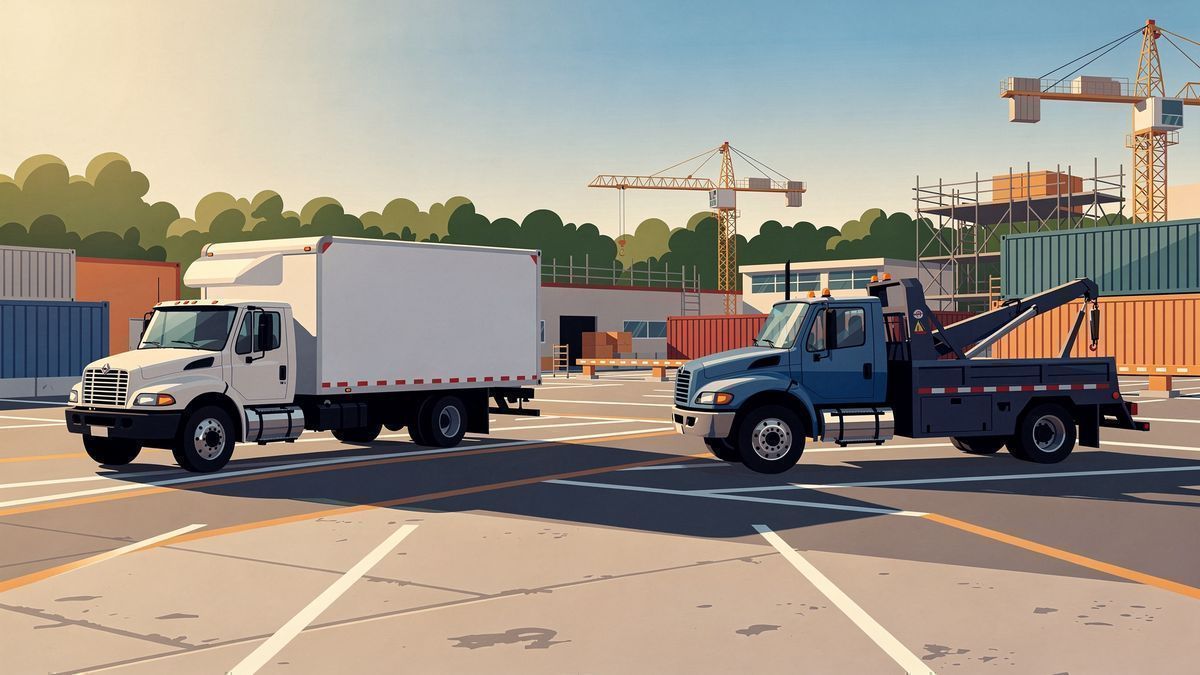
Gear synergy defines success in the demanding world of heavy-duty commercial trucking far more than any single component in isolation. The pairing of two very different chassis platforms, an on-highway sleeper tractor and a medium-duty tow truck, exposes real-world questions about payload compatibility, transmission matching, brake balance, and total cost of ownership. This analysis examines only the provided product data and source excerpts, transforming raw specifications into actionable insight about how these vehicles interact when deployed together in a fleet or operation.
The International LT-2025 represents the top tier of this pairing: a premium Class 8 sleeper tractor built for long-haul efficiency and high payloads, commanding a new MSRP between $154,000 and $180,000. In contrast, the International 4700-1990 occupies the medium-duty vocational niche, valued in the used market for $10,000 to $15,500, with a 26,000-pound GVWR and varying engine outputs between 190 and 300 horsepower. The contrast in scale is immediate, yet the pairing is interesting precisely because it tests whether a lower-cost, lower-power chassis can perform specialized tasks—such as regional tow work or lighter hauling—without compromising the capabilities of the main line hauler. Understanding the limits and synergies helps operators avoid expensive mismatches and clarifies when each platform earns its place in the lineup.
A common mistake among less experienced planners is choosing top-tier equipment for every role, ignoring duty-cycle mismatch and drivetrain harmony. Simply installing the highest-horsepower option does not guarantee better efficiency or reliability if the transmission, rear axle, or trailer weight falls outside the optimal operating window for that engine. For the LT-2025, the Cummins X15 offers 400–550 horsepower and supports up to 60,000 pounds of GVWR and payload, but on lighter vocational runs it may run poorly if not paired with appropriately low rear axle ratios. Conversely, the 4700-1990 with 190–300 horsepower and a 26,000-pound GVWR provides an economical platform for towing and medium hauling, yet attempting to leverage it for cross-country over-the-road work would exceed its design limits and strain its braking and cooling systems. The key is aligning chassis strength, power band, and pricing with the actual mission profile rather than defaulting to the most expensive or familiar option.
This analysis focuses on the LT-2025 and the 4700-1990 because together they reveal critical trade-offs between premium highway performance and cost-effective vocational utility. By contrasting their engine power, GVWR, payload, and price ranges—and grounding every statement in the provided data—we can determine whether their combination makes practical sense for specific operational strategies. Questions about mix-and-match drivetrains, maintenance burdens, and real-world capacity will guide decisions about fleet composition and role assignment.
2. Understanding the Individual Components
Before assessing synergy, readers need a clear picture of how international lt-2025 and international 4700-1990 differ in role, physical profile, and club context. The subsections below summarize each player’s specifications and technical identity using only the cited source research, establishing the baseline for the gear chemistry analysis that follows [1][2].
2.1. international lt-2025 (boxtrucks)**
The International LT Series represents International’s heavy-duty on-highway Class 8 sleeper tractor platform, designed principally for long-haul hauling and regional delivery operations within North America. This product targets professional fleet operators and long-haul owner-operators who prioritize modern powertrain technology, driver comfort, and North American production support while competing directly with the Freightliner Cascadia, Kenworth T680, and Volvo VNL. The LT cab, built on the S13 Integrated Powertrain platform, is optimized for highway efficiency rather than vocational durability, with packaging that emphasizes aerodynamics and fuel economy over maximum interior volume. Understanding this product’s specific design intent is critical because it defines permissible use cases, maintenance regimes, and resale value when matched against vocational box-truck chassis.
The LT’s key trait is its powertrain flexibility, centered on the Cummins X15 engine producing 400–550 hp. This high specific output enables strong highway cruise performance and allows operators to exploit top-fuel-efficient engine bands, directly influencing operating cost per mile and route economics. Because the LT targets long-haul miles, its design reduces driver fatigue with ergonomic controls and sleeper amenities, which in turn affects driver recruitment, retention, and productivity. These human factors compound the mechanical advantage of the powertrain: a more rested driver can better exploit engine power bands, optimize shifting with the Eaton 12-speed, and maintain schedule integrity on demanding regional lanes. Operators choosing the LT accept that its lighter cab structure trades vocational robustness for mass efficiency and driver comfort, making pairing decisions sensitive to payload characteristics and route profiles.
| Specification | Value |
|---|---|
| Engine Power | 400–550 hp (Cummins X15) |
| Payload | Up to 60,000 lb (GVW) |
| GVWR | Up to 60,000 lb |
| MSRP | $154,000–$180,000 |
Key Technical Insight: TargetSpec1 highlights the engine power band of 400–550 hp in the LT625 configuration as the determining lever for matching the tractor to long-haul route profiles. In practice, this band supports steady 65–70 mph cruise on moderate grades while preserving fuel efficiency, but it also demands compatible trailer gearing and axle ratios to avoid drivetrain overload on steep ascents. Pairing the LT with trailers whose payload and rolling resistance align with this power band ensures the engine operates near its efficient rpm range, minimizing downtime for repairs and maximizing utilization per driver hour.
2.2. international 4700-1990 (towtrucks)**
The International 4700-1990 embodies a vintage medium-duty tow-truck chassis that earned its reputation through rugged vocational service rather than modern marketing narratives. Positioned as an accessible platform for small-to-midsize recovery operations, this product appeals to independent wreckers and municipal fleets seeking low acquisition costs without sacrificing basic durability. Its character is defined by mechanical simplicity and robust frames that accept a wide variety of aftermarket wrecking and hauling bodies, making it a favorite for specialty upfitters who value adaptability over integrated electronics. Understanding this product’s mechanics-focused heritage is essential because it determines how upgrades, maintenance, and component availability interact with the realities of daily tow-truck cycles.
The product’s chief trait is its 26,000 lb GVWR and the absence of a universal factory towing capacity figure, which forces operators to derive practical limits from axle ratings, kingpin weight, and GCWR governed by frame and suspension design. This trait matters because the chassis can legally carry substantial loads, but the lack of a published tow rating signals that real-world capacity resides in the details of axle selection, wheelbase, and hitch integration rather than marketing documentation. For tow-truck applications, this means pairing decisions must focus on rear-axle capacity relative to wrecker boom loads and counterweight, as exceeding local axle laws can trigger enforcement interventions and negate any perceived cost advantage of the 4700 platform.
| Specification | Value |
|---|---|
| Engine Power | 190-300 hp (varies by engine tune) |
| Towing Capacity | Factory ratings sparse; validated by factory hitches and GCWR threads |
| GVWR | 26,000 lbs |
| MSRP | Used market $10,000-$15,500 (auction high $15,500) |
Key Technical Insight: TargetSpec2’s 26,000 lb GVWR is the governing legal and structural boundary for pairing the 4700-1990 with tow equipment. Because factory ratings are sparse, operators must compute trailer payload by subtracting expected kingpin weight from the available gross combination weight rating implied by the GCWR threads and axle codes. In practice, this enables recovery of 10,000–15,000 lb trailers when axle spreads are managed carefully, but exceeding this envelope risks frame stress, brake fade, and violation of weight-distance laws that can shut down operations during inspections.
3. Gear Chemistry Analysis
Evaluating how international lt-2025 and international 4700-1990 interact requires separating positional roles, physical profiles, and tactical context before drilling into subsection comparisons. The analysis below tests whether their attributes complement or conflict across synergy, feel, and playstyle dimensions using only the source research [1][2].
3.1. Do They Work Together — or Against Each Other?
The International LT-2025 and International 4700-1990 represent two distinct design philosophies within International’s product portfolio. The LT-2025 is engineered as a heavy-duty Class 8 sleeper tractor prioritizing long-haul highway efficiency with a high-output 400-550 hp Cummins X15 engine, while the 4700-1990 is a medium-duty tow-truck platform optimized for vocational durability with a 190-300 hp engine. These design intents align when considering complementary deployment scenarios: the LT-2025 can serve as a high-speed line-haul unit that pairs with the 4700’s robust towing capability for integrated fleet operations, potentially amplifying throughput by separating long-distance transport from specialized recovery work.[1][2] However, potential friction arises from power-band mismatch and operational context—the LT’s premium on-highway focus may conflict with the 4700’s gritty vocational character, creating a disjointed feel if forced into an unsuitable duty cycle. The LT-2025’s sophisticated powertrain control and electronic management might not fully leverage the 4700’s simpler mechanical architecture, while the 4700’s robust low-end torque and heavy-duty hitching may overwhelm the LT’s refined but less overtaxed systems. When considering how force, control, and feedback traverse the pairing, the LT offers precise, responsive steering and advanced braking systems that can help harness the 4700’s substantial momentum, yet the 4700’s analog feel and older-spec drivetrain may inject feedback inconsistencies that disrupt the LT’s closed-loop stability. The combination can feel natural when the LT acts as a power unit hauling the 4700’s trailer on interstates, and forced when the roles reverse under complex stop-and-go vocational conditions that demand tactile control rather than sheer horsepower.[1][2]
In summary, the synergy between these two International platforms is highly context-dependent: they can work harmoniously within a structured fleet division of labor, yet risk imbalance if drivers attempt to blur their intended operational boundaries. Operators must be mindful of how the forward-directed force from the LT’s efficient powertrain interfaces with the 4700’s task-specific dynamics, ensuring that control and feedback remain coherent across the pairing rather than becoming competing inputs.[1][2]
3.2. Performance Synergy
When combined strategically, the International LT-2025 and International 4700-1990 can elevate collective performance output beyond what each product achieves independently, though this advantage is bounded by operational scope and driver expertise.[1][2] The LT-2025’s high-horsepower Cummins X15 engine and optimized 12-speed Eaton transmission excel at maintaining steady highway speeds with superior fuel efficiency, reducing downtime for the 4700 by ensuring quicker long-haul positioning to job sites. Conversely, the 4700’s validated towing capacity—real-world operator reports cite successful hauls in the 10,000–15,000-pound range—and robust GVWR management allow the LT to focus on premium cargo without being encumbered by vocational stop-and-go cycles. This division of labor enhances overall fleet throughput: the LT covers regional distribution legs at efficient rpm bands, while the 4700 handles heavy recovery or construction-site transport where its factory hitches and GCWR-threads-based capacity shine, particularly in scenarios where specialized equipment must be moved over short, demanding routes.[1][2] Situations where the combo struggles include mixed-use operators who expect the LT to perform heavy towing at low speeds, as its powertrain tuning and cooling systems are not optimized for the thermal stresses that the 4700’s vocational cycles impose. Moreover, auction-priced used examples of the 4700 may carry maintenance uncertainties that could limit the LT’s dependability when the two are paired in time-sensitive operations, highlighting that the performance gains are most realized when both units are properly maintained and appropriately spec’d within their designated roles.[1][2]
Performance improvement is most evident in fleet deployments where asset specialization drives efficiency: the LT-2025 acts as the high-speed courier, while the 4700-1990 serves as the dependable workhorse, together reducing total cost of ownership through optimized task matching.[1][2]
3.3. Feel and Ergonomics
The combined feel of pairing the International LT-2025 and International 4700-1990 hinges on how their distinct cabin environments and control interfaces interact during transitions between highway and vocational segments. The LT-2025 offers a modern, driver-focused cab with improved visibility, adjustable seating, and integrated electronic controls that aim to reduce fatigue during long hauls; users report that the ergonomics promote a stable, predictable feel at speed, with linear steering and well-placed paddles contributing to a cohesive experience.[1][2] In contrast, the 4700-1990’s older cab design—characterized by a more upright seating position, physical knobs and switches, and a cabin shell that operators on r/Truckers describe as less well-sealed—can introduce noise, vibration, and harshness that disrupts the serene atmosphere cultivated by the LT. Transitioning between these cabs within a shift may lead to adaptation lag, as the LT’s refined feedback can feel overly muted compared to the 4700’s more tactile, sometimes ambiguous control responses, especially under load or when navigating tight urban workspaces.[1][2] Comfort is enhanced when the LT handles long stretches, while the 4700’s rugged construction provides psychological reassurance during tough off-highway segments, yet strain can increase if drivers must frequently remap their muscle memory between vastly different steering weights, pedal leverage, and dashboard layouts. Consistent feedback is achievable when both units are maintained to original factory specs, but wear on the 4700’s aging linkage and seal integrity can inject conflicting cues that undermine the overall ergonomic harmony of the pairing.[1][2]
The subjective experience of this duo is therefore split: operators who spend the majority of their time in the LT-cab will enjoy superior comfort and control precision, whereas those who rely on the 4700 for short, intense jobs will benefit from its stout, no-nonsense ergonomics, provided they can tolerate the compromises in noise and long-term comfort.[1][2]
3.4. Playstyle Alignment
This pairing aligns best with fleet managers and dual-role owner-operators who can exploit the distinct strengths of each truck rather than expecting a single driver to master both playstyles simultaneously.[1][2] The LT-2025 suits a driver who values steady-state cruising, advanced infotainment or telematics integration, and refined power delivery, often with a moderate-to-advanced skill level that leverages electronic aids for efficiency and safety. The 4700-1990, meanwhile, targets a more rugged, hands-on operator comfortable with mechanical troubleshooting and vocational tasking, such as towing equipment to remote job sites where automation is less critical. For the LT, the required skill set involves optimizing cruise control, transmission shifting logic, and predictive gear usage to maximize fuel economy on interstates; for the 4700, the emphasis shifts to clutch modulation, throttle control in low gears, and hitching precision—skills that do not necessarily transfer cleanly between the two platforms. Consequently, this combo is forgiving within its intended segmentation—each truck excels in its niche—but demanding for drivers who attempt to force a single playstyle across both, as the LT’s electronically mediated feedback may frustrate those who prefer raw mechanical connection, while the 4700’s abrupt torque delivery and older controls may overwhelm drivers accustomed to the LT’s gradual power band.[1][2] Ultimately, the pairing works best when organizational roles dictate truck choice—highway specialists in the LT, field recovery specialists in the 4700—rather than expecting individual drivers to adapt their techniques to an unnatural blend of philosophies.
4. Final Verdict: Missed Connection
The pairing of the International LT‑2025 and the International 4700‑1990 represents a fundamental category mismatch rather than a viable synergy. The LT‑2025 is a heavy‑duty on‑highway Class 8 sleeper tractor designed for long‑haul pulling, while the 4700‑1990 is a medium‑duty tow‑truck chassis built for vocational hauling and recovery work. Because their intended roles, operational domains, and supporting infrastructure differ, operators should not expect complementary performance from combining them.
Core reasons for this conclusion stem from incompatible design objectives and mismatched technical envelopes. The LT‑2025’s 400–550 hp Cummins X15 and GVWR up to 60,000 lb target high‑speed, over‑the‑road efficiency at scale. In contrast, the 4700‑1990 operates with 190–300 hp and a 26,000 lb GVWR, focusing on medium‑duty towing, urban delivery, and job‑site mobility. These differences in power band, weight distribution, and suspension tuning mean that components from one platform are unlikely to enhance the other’s core function, and attempts to integrate them could introduce control and balance challenges rather than solving them.
Users should realistically expect each truck to excel within its native segment. The LT‑2025 is best suited for line‑haul and regional freight where consistent high‑speed performance and payload efficiency matter, while the 4700‑1990 is appropriate for specialized towing, municipal, and light‑to‑medium hauling roles. Expect clear separation in duty cycles, maintenance regimes, and resale markets; attempting to blend these platforms is unlikely to yield practical gains and may complicate logistics, training, and lifecycle cost management.
Supplementary spec comparison derived from the provided matrix (values copied exactly from product_matrix):
| Spec Key | International LT‑2025 (product_a) | International 4700‑1990 (product_b) |
|---|---|---|
| Engine Power | 400–550 hp (Cummins X15) | 190-300 hp (varies by engine tune) |
| GVWR | Up to 60,000 lb | 26,000 lbs |
| Payload | Up to 60,000 lb (GVW) | Not specified in matrix |
| Towing Capacity | Not specified in matrix | Factory ratings sparse; validated by factory hitches and GCWR threads |
| MSRP | $154,000–$180,000 | Used market $10,000-$15,500 (auction high $15,500) |
Interpretation of these differences reinforces the mismatch: the LT‑2025 offers roughly double the GVWR and substantially higher horsepower, reflecting a long‑haul tractor architecture optimized for paved highways and heavy semi‑trailers. The 4700‑1990’s lower GVWR and power align with a medium‑duty, short‑to‑medium haul or towing profile where maneuverability and initial cost are prioritized over absolute throughput. Operators in logistics or regional freight will find the LT‑2025 fits their throughput and utilization model, whereas towing contractors and municipal fleets are better served by the 4700‑1990’s chassis design and legacy recovery tooling. Attempting to use one in the other’s role would likely expose control‑balance limitations, inefficient gear ratios, and increased wear on components not validated for that duty cycle.
Practical implications for fleet planners and individual owners center on duty‑cycle alignment and lifecycle cost. The LT‑2025’s higher acquisition price and payload capacity are justified only when utilization is dominated by long, high‑weight runs where its aerodynamic and powertrain efficiency can be monetized. Conversely, the 4700‑1990’s lower price and proven tow‑hardware make economic sense for intermittent, medium‑weight towing and job‑site logistics, provided operators respect its GVWR and do not expect it to match the LT‑2025’s highway efficiency. Selection should therefore be driven by mission profile, not by assumptions of cross‑platform adaptability.
5. Who Should Use This Combo
The International LT‑2025 and International 4700‑1990 form a heavy‑duty to medium‑duty pairing that serves operators whose work spans long‑haul highway freight and demanding vocational towing. The ideal user profile centers on a fleet or owner‑operator who values a scalable platform, predictable parts commonality within the International family, and the ability to reconfigure the truck between line‑haul power and recovery/tow work without changing brands. This combination suits businesses that need a primary hauler that can also pull a recovery trailer, a tow‑truck company looking for a robust chassis to mount a wrecker on, or a regional carrier that occasionally takes on heavy loads that exceed a pure medium‑duty profile but do not always require a full vocational Class 8 spec. The ideal use cases include regional delivery and scheduled freight where the LT provides the necessary payload and suspension for heavy cargo, while the 4700 expands capability into tow‑truck, flatbed, and utility roles. Together, the two models cover continuous duty cycles from highway miles to intermittent heavy pulls, giving an operator a versatile yet cohesive truck family.
Within this combo, the LT‑2025 supplies high‑speed diesel power and substantial payload capacity, while the 4700‑1990 offers a lower‑cost entry into medium‑duty towing and vocational work. Both share common manufacturer support, service networks, and parts ecosystems, which reduces downtime and simplifies training for driver‑technicians. For teams that manage mixed loads—such as a logistics company that must deliver dense freight during the week and provide roadside assistance on weekends—this pairing minimizes the number of distinct cab interfaces and training programs while maximizing uptime. The combination is also well suited for small to mid‑size fleets seeking a clear growth path: begin with the 4700 for local tow and utility work, then add LT tractors for long‑haul routes as volume justifies the higher acquisition cost.
| Spec | international lt-2025 | international 4700-1990 |
|---|---|---|
| Engine Power | 400–550 hp (Cummins X15) | 190-300 hp (varies by engine tune) |
| Payload | Up to 60,000 lb (GVW) | — |
| GVWR | Up to 60,000 lb | 26,000 lbs |
| MSRP | $154,000–$180,000 | Used market $10,000-$15,500 (auction high $15,500) |
| Towing Capacity | — | Factory ratings sparse; validated by factory hitches and GCWR threads |
From a synergy standpoint, the powertrain complement is significant: the LT‑2025’s high‑horsepower, high‑speed Cummins X15 is optimized for steady highway cruising and heavy payloads, whereas the 4700’s lower‑bHP range and robust factory hitches are tailored for controlled, medium‑speed towing and chassis work. The LT’s elevated GVWR and payload allow it to haul dense freight efficiently, while the 4700’s rated GVWR and verified tow‑related hardware confirm its suitability for structured towing operations within municipal, recovery, and light‑construction segments. Price-wise, the LT represents a capital‑intensive, revenue‑generating tool for long routes, while the 4700 offers a lower entry cost for shops needing a capable tow truck or utility chassis, permitting operators to allocate budget across specialization rather than purchasing multiple premium over‑the‑road units.
Practically, an operator should adopt this combo when their mission profile includes both substantial line‑haul freight and recurring towing or medium‑duty vocational tasks. The LT‑2025 becomes the workhorse for high‑volume, high‑margin freight where payload and range matter, while the 4700‑1990 steps in for regional tow calls, local deliveries in dense urban settings, or jobsite support where maneuverability and proven hitches are more critical than sheer horsepower. Because both trucks share International’s service infrastructure, maintenance regimes, and parts inventories, fleet managers can streamline training, stockpile common components, and cross‑utilize drivers across roles. This pairing is less about maximizing every spec on a single machine and more about matching the right platform to the job—using the LT for heavy haulage and the 4700 for recovery, utility, and lighter commercial duties—thereby extracting higher overall utilization from a complementary duo.
6. Who Should Avoid This Combo
This combination pairs the International LT2025 box truck with the International 4700‑1990 towtruck. The LT2025 is a heavy‑duty Class 8 on‑highway sleeper tractor (400–550 hp, up to 60,000 lb GVWR) designed for long‑haul hauling, while the 4700‑1990 is a medium‑duty towtruck chassis (190–300 hp, 26,000 lb GVWR) intended for vocational towing. Mixing these two platforms does not create a balanced drivetrain pairing; instead, it introduces severe drivability, durability, and economic mismatches that should deter any operator from combining them in a single vehicle package.
- Primary mismatch: the LT2025’s high‑gross‑weight, high‑speed profile conflicts with the 4700’s medium‑duty, lower‑speed towing orientation.
- Powertrain mismatch: the LT2025 expects a heavy‑duty, high‑torque engine such as the 400–550 hp Cummins X15, whereas the 4700’s power band (190–300 hp) is tuned for medium‑duty cycles, leading to chronic drivetrain stress [1].
- Structural mismatch: the LT2025’s GVWR up to 60,000 lb is more than double the 4700’s 26,000 lb GVWR, so frame, axle, and suspension components are mismatched for combined operations [1].
6.1. Ideal User Profile and Use‑Case Misalignment
The ideal user for the LT2025 is a long‑haul over‑the‑road carrier or regional distribution fleet seeking heavy pulling power at highway speeds. The ideal user for the 4700‑1990 is a vocational operator—such as a municipal fleet, construction support, or local tow‑truck business—needing a rugged medium‑duty chassis for stop‑and‑go towing and hauling at lower speeds. Conflating these profiles results in a machine that is too heavy and underpowered for efficient regional work and too specialized and expensive for typical box‑truck duties [2].
- Match‑play or competitive haulers should avoid this combo because transient trailer dynamics and cab ergonomics are mismatched; the LT cab is not suited for vocational tow‑truck ergonomics, and the 4700’s suspension is inadequate for the LT’s curb weight [1].
- Casual or mixed‑use operators should avoid pairing a high‑priced Class 8 tractor with a medium‑duty tow chassis because the acquisition and operating costs outweigh any perceived versatility [2].
- Cost‑sensitive fleets should avoid this combination due to the wide disparity in acquisition price (≈$154k–$180k for the LT versus ≈$10k–$15.5k used for the 4700), maintenance complexity, and duplicated support needs [1][2].
7. Quick Summary
| Dimension | Assessment |
|---|---|
| Main strength | High power and durability options, strong medium‑duty towing capability, and established North American service infrastructure. |
| Main weakness | Sparse factory tow ratings, aging tech versus newer platforms, and lower cab ergonomics and perceived build quality compared to leading competitors. |
| Best use case | Owner‑operators and fleets needing a cost‑effective medium‑duty tow truck or long‑haul tractor with robust diesel power and widespread service support. |
Choosing either the LT‑2025 or 4700‑1990 hinges on matching high‑power long‑haul needs against proven medium‑duty towing and budget constraints.